|
Death and Elections
|
|||||
|
PERSONALITIES | FEATURES | NEWS
The Kao case shows that stereotyping is a virulent strain of racism that can not only kill but also protect the killer from the consequences. I tend to blame Hollywood for that evil. When I am trying to choose a political leader, racial scapegoating is the evil foremost on my mind. Since Gold Rush days, mobs have seen Asian Americans as handy targets on which to unleash anger produced by two types of crises — military and economic. Japanese Americans — and anyone who looked like them — became scapegoats for Japan's military attack on Pearl Harbor. Our military conflicts with Corea (Korea), Vietnam and China have made scapegoats of anyone who looks like a “gook” or a “chink”. |
|
||||
|
404
Not Found
|
|||||
|
Economic competition has bred just as much ill will toward the Asian race. The success of Japanese imports — combined with the grievous weakness of the American auto industry during the 70s and 80s — produced so many laid-off workers that smashing Toyotas and Nissans with baseball bats became a cultural icon. That news footage may well have inspired people like Ebens to take a bat to people like Vincent Chin whose only connection to Japanese imports is that his ancestors originated from the same continent. Today the outsourcing of service and tech jobs to highly-trained, English-fluent Indians is inspiring new backlash against South Asians among laid-off workers in the hi-tech industries.
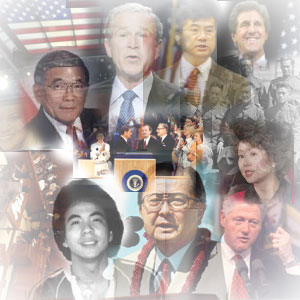
During the past three decades republican presidents have tended to escalate military tensions with Asia while downplaying trade conflicts. (Before that, it was Lyndon Johnson, a democrat, who escalated the Vietnam War while Richard Nixon, a republican, ended it and opened up relations with China.) Democrat presidents have tended to escalate economic tensions while toning down geopolitical rhetoric. I can't say whether racist acts against Asian Americans are inspired more by scapegoating us as military or as economic threats. It's a safe bet that both notions swarmed through the overheated brains of those who committed mayhem and murder against their Asian victims. This year's presidential election is a tough one. On the one hand, I must consider George Bush branding North Corea as a member of the “Axis of evil”, and treating China as a geopolitical threat which, in the minds of many Americans, puts anyone looking Asian into the enemy camp. On the other, I am trying to figure out what John Kerry means when he keeps talking about stopping the loss of American jobs. I don't think he's a protectionist, but he seems to be putting undue blame for the uncertain economy on American companies sending work to Asian workers which is a mere symptom of larger economic trends. If you are skeptical about the impact presidents have on the social climate, consider that they appoint Supreme Court justices who, in turn, set legal precedents for judges across the nation. Their interpretations of legislation and legal precedent can influence everything from police procedures to the access to hate crimes legislation to prosecute racists, literally making the difference between life and death for Asian Americans victims and prospective victims. They also appoint the U.S. attorneys who have the discretion as to which cases will be prosecuted under various federal laws, including civil rights statutes. If you're still unsure, consider how American society's attitude toward Asians might have been influeced if Chester Arthur had the political support to hold firm to his initial veto of the Chinese Exclusion Act of 1882, if FDR had faced down alarmists and refused to sign Executive Order 9066, or if John Kennedy had not summoned the courage to pledge the nation to full racial equality by enacting far-reaching civil rights laws. And don't forget the importance of having the right political leadership in other branches of government. A right-wing uprising led by Congressman Newt Gingrich held President Bill Clinton's policies hostage while pushing the nation repeatedly toward pointless military and trade confrontation with China — to the discomfiture of all Asian Americans. Sure, I care about taxes, the economy, the environment, poverty, crime and all the other issues. But they are secondary to the dangers posed by a leader who uses Asians the way Hollywood has done so often in the past: as convenient scapegoats on which to paint a bullseye. |
|
||||