|
PERSONALITIES
|
FEATURES
|
NEWS
Donald Tsang:
British
Knight on Hong Kong's Throne
 hina tried having a patriotic tycoon run the nation's richest city. But on Tuesday, the Communist leadership gave Hong Kong's top job to a completely different person: a devout Roman Catholic who wears colorful bow ties and proudly holds the honor of British knighthood.
Donald Tsang's promotion as Hong Kong's leader, or chief executive, made him a classic political survivor. Many thought his career would peak eight years ago, when this former British colony was handed back to China with the promise it would enjoy a wide degree of autonomy.
It was in the final days of colonial rule that Prince Charles tapped Tsang's shoulders with a sword and made him a knight _ a reward for his three decades of service as a loyal civil servant. Tsang's achievements included becoming the first ethnic Chinese to be appointed as financial secretary.
Many thought Tsang's knighthood would be a curse in the new China system. Beijing has long been a sworn enemy of imperialism and all its trappings. Tsang's willingness to accept the British honor was read as a sign that he was sabotaging his own career.
But he stuck with it and continued to rise in the new Hong Kong. He kept wearing his snazzy trademark bow ties. And he continued going to church, though his Communist masters in Beijing were atheists.
His boss in Hong Kong was Tung Chee-hwa, a millionaire scion of a shipping family with close ties to Beijing but little experience in politics or government.
Tung was widely viewed to be a disaster during his eight years as chief executive. A hard worker, he was nicknamed ``7-11'' because he got to work at 7 a.m. and clocked out at 11 p.m. But he struggled to connect with the common people, and many believed he was too cozy with the business elite. There were massive street protests demanding the right to directly elect leaders.
Three months ago, Tung abruptly resigned with two years left in his term, saying he was quitting because of failing health. It's widely believed that Tung was really dumped by Beijing, which was worried he was losing control of an increasingly politicized society.
Ê
|

Donald Tsang, former acting chief executive, gestures during a press conference in Hong Kong Thursday, June 2, 2005. Donald Tsang moved closer to his widely expected selection as Hong Kong's next leader when he won Beijing's approval to campaign for the top job in this Chinese territory.
(AP Photo/Vincent Yu)
|
|
|
As the No. 2 ranking leader, Tsang became the acting chief executive. It seemed that China wanted to try a different approach. The Communist leadership seemed less interested in finding someone with a pro-Beijing, patriotic background.
It was more important to have someone with solid administrative experience. Someone savvier and more popular with the public. Someone like Tsang.
On Tuesday, Chinese Premier Wen Jiabao announced that Tsang had received the job after winning most of the votes from an 800-member committee that picks Hong Kong's leaders.
``I believe that Mr. Donald Tsang and Hong Kong's government will definitely be able to lead all of Hong Kong's people in overcoming all difficulties,'' Wen said. ``He'll advance Hong Kong's prosperity and stability.''
Few expect Tsang to push for full democracy. He has a reputation of being loyal to his superiors and carrying out orders. He's only serving out the last two years of Tung's term, so he'll be under Beijing's strict political probation.
In recent months, he has repeatedly pointed out how close he is to the average Hong Konger. He has noted his humble origins as a policeman's son. He worked briefly as a pharmaceutical salesman before entering the government. He never went to college for an undergraduate degree, though he did finish a one-year master's degree in public administration at Harvard University.
``The many Hong Kong stories that I heard have served to remind me of one important truth,'' he said Tuesday. ``That most people's concerns are honestly simple _ the rough and tumble of everyday life.''
Tue June 21, 2005 11:51 EDT HONG KONG (AP)
|
|
“Most people's concerns are honestly simple — the rough and tumble of everyday life.”
|
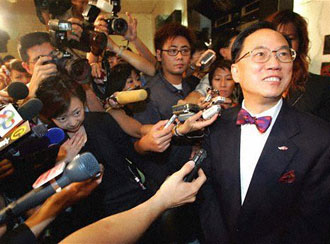
Former acting chief executive Donald Tsang speaks to reporters outside his campaign office in Hong Kong Thursday, June 2, 2005.
(AP Photo/Vincent Yu)
|
|
|
HOME
|
PERSONALITIES
|
FEATURES
|
NEWS
|
© 1996-2025 Asian Media Group Inc
No part of the contents of this site may be reproduced without prior written permission.
|
|
