

The Oscars Turned into a Golden Celebration of Pan-Asian Representation
By Romen Basu Borsellino | 16 Mar, 2026
K-Pop Demon Hunters set a rhapsodic stage for a memorable recognition of pan-Asian American talent at Sunday night’s 2026 Academy Awards.
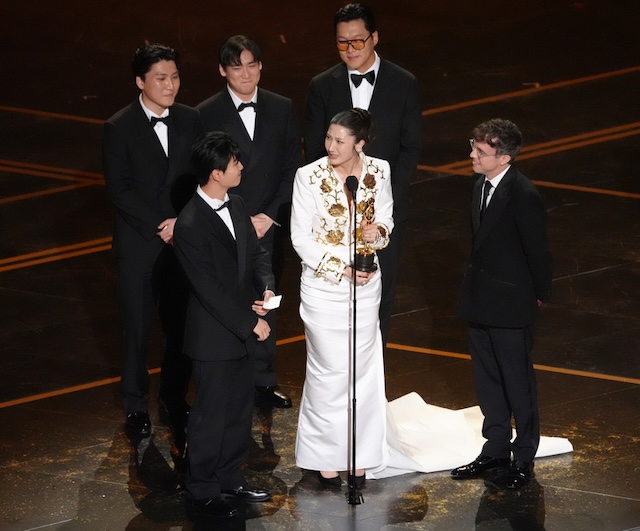
Joong Gyu Kwak, from left, Yu Han Lee, Hee Dong Nam, EJAE, center, Jeong Hoon Seo, Mark Sonnenblick accept the award for best original song for 'Golden' from "K-Pop Demon Hunters."
After thanking the Academy, the fans, and “all those of you who look like me,” KPop Demon Hunters co-writer and director Maggie Kang who was accepting the Oscar for Best Animated Feature, offered the audience an apology:
“I’m so sorry” she told the 3,400 attendees at the 98th at annual Academy Awards in Hollywood and estimated 20 million watching at home, “that it took us so long to see us in a movie like this. But it is here and that means that the next generations don’t have to go longing.”

The live performance of "Golden" effectively turned the Academy Awards into a K-pop concert
I had the sneaking suspicion that “us” was neither a reference to K-Pop superstar trios nor demon hunters, particularly when Kang dedicated the award to “Korea and Koreans everywhere.”
But I also don’t think that she was speaking solely to Koreans. This was a win for Asian Americans and Asians all across the globe.
2023: A tough act to follow
Monday morning’s top headlines were largely about "One Battle After Another" winning big with awards for Best Picture, Best Director Paul Thomas Anderson and Best Supporting Actor Sean Penn. And of course "Sinners" Best Actor Michael B. Jordan’s win and subsequent jaunt to California burger staple In-N-Out — a post Oscars tradition for winners — statue still in hand.

Kumail Nanjiani presented the award for Best Short Film
It’s safe to say that this year fell short of Asian Americans' high water mark at the 2023 Oscars, the year "Everything Everywhere All at Once" made Michelle Yeoh the first Asian woman to win best actor while also delivering a Best Supporting Actor statue for Ke Huy Kwan, Best Director and Best Original Screenplay awards for Daniel Kwan, and a Best Picture statue for producer Jonathan Wang.
Not to mention that Yeoh’s win came 65 years after the most recent Asian American, Miyoshi Umeki, had won for best acting.
But while our community may be known for perfectionism, it needn’t take a clean sweep for us to celebrate. Sure, say, Chloe Zhao, who won Best Director in 2022 for "Nomadland" was nominated for "Hamnet" this year but did not win. But those of us watching on Sunday night certainly took note of our victories both win-related and otherwise.
Golden
To be clear, anyone who follows awards season closely or just happened to notice that "K-Pop Demon Hunters" was Netflix’s most streamed movie of all time probably knew that the film was a front runner in the categories for which it was nominated.
But whether or not they took home the statues for Best Animated Feature and Best Feature Song for “Golden” —which they did — the awards show was bound to be a celebration of the film.
There were just two live musical performances during the this year's Oscars and “Golden” was one of them. The Academy has generally scaled back live performances in recent years, which made this one feel even more special.
"Our music unites the soul and brings people together,” a voice stated as percussionists emerged beating long barrel drums and dancers in traditional Korean hanbok took the stage.
The film’s hardcore fans surely recognized what was happening immediately. But for those who didn’t it became clear the moment the curtain opened and the film’s three lead voice actors —EJAE, Rei Ami, and Audrey Nuna — descended a staircase dressed in all white to perform the hit.
But just as cool as the performance was the way in which the entire ceremony had seemingly been turned into a K-Pop concert in just a matter of seconds. Light sticks were handed out to audience members including Leonardo DiCaprio, Emma Stone, and Steven Spielberg, all of whom were shown waving them.
Simply put, the performance brought the house down.
And the other musical display of the night wasn’t without AAPI influence as well. A live rendition of “I Lied to You” from "Sinners" featured surprise cameos from a number of actors and performers including Li Jun Li, who played Chinese American grocery store owner Grace Chow.
Cinematography
Fittingly, the live “Golden” performance began immediately after the award was presented for Best Cinematography, which went to Autumn Durald Arkapaw.
This means that if you watch the performance on YouTube, you can see her walking off stage holding her Oscar as the song begins, making it the perfect AAPI celebration.
Durald Arkapaw, who is half-Filipino and half-Black, became the first woman and first woman of color to win the Oscar for Best Cinematography. In the award's 97-year history, only three women had ever even been nominated before her.
When she took the stage, she invited every woman in the Dolby Theatre to stand up. Backstage, she put it more simply: "A lot of little girls that look like me will sleep really well tonight."
It's also worth noting that Arkapaw had already made history before she ever got to the ceremony: She was the first female cinematographer to shoot on large-format IMAX film, a key characteristic of Sinner's stunning beauty.
South Asians
South Asians specifically had a night worth celebrating as well.
Bollywood superstar turned Hollywood superstar Priyanka Chopra Jonas took the stage to present an award, as did Pakistani American actor Kumail Nanjiani, who made history in a way that had nothing to do with his identity: He presented the awards for Best Short Film, which ended up being split by two winners who had both received an equal number of votes. This had only happened three times in the Award Show’s nearly 100-year history.
“Ironic that the short film category is going to take twice as long” the funny man quipped before letting each of the two winners come up one by one to accept the awards and give remarks.
One of the two films to win the short was “Two People Exchanging Saliva, which was co-directed by Alexandre Singh, an Indian American who has spoken about his father, a Punjabi immigrant who struggled to assimilate when coming to the US in the 1960s given his beard and turban which he eventually got rid of.
The night’s only other Indian American nominee Geeta Gandbhir held the distinction of being nominated in two separate categories for different films: documentary short “The Devil is Busy” and Documentary Feature “The Perfect Neighbor” both of which came up short.
And the Award Goes to…
The Academy Awards have so consistently been devoid of AAPI representation that it takes very little to make history as was the case in 2023, this year, and in various ways in any given year.
Hopefully it won’t take long until there is little history left to be made. But until then, we need to continue to celebrate every win, whether or not it involves taking home a statue.
And as much as I love In-N-Out, I’m still waiting for an Oscar winner to take their statue to Panda Express.
I had the sneaking suspicion that “us” was neither a reference to K-Pop superstar trios nor demon hunters, particularly when Kang dedicated the award to “Korea and Koreans everywhere.” But I also don’t think that she was speaking solely to Koreans. This was a win for Asian Americans and Asians all across the globe.
Articles
- EU's Kallas Denounces US Iran Strikes, Seeks Diplomatic Solution
- Microsoft Reorganizes Copilot Team for Superintelligence Push
- Top US Counterterrorism Official Quits, Says No Basis to Attack Iran
- US Home Sales Had Been Rebounding Before Mideast Conflict
- How Filipinos Became the Most Numerous Non-Citizens Serving in the US Military
- GM Partners with LG Energy to Reopen Tennessee Battery Plant
- The Oscars Turned into a Golden Celebration of Pan-Asian Representation
- LG Energy to Supply US-Made LFP Batteries to Tesla in $4.3-Billion Deal
- JPMorgan Asia Promotes David Lau, Poaches Yi Zhang from Goldman
- Alibaba Joins Other China Tech Giants in OpenClaw Craze with Agentic AI Platform