
|
PERSONALITIES | FEATURES | NEWS
ASIAN AMERICAN AIR FORCE
 ou see them everywhere, the beautiful, articulate Asian talking heads who feed America the day's events and gossip. Notwithstanding Connie Chung's recent fall from the CBS Evening News co-anchor chair, the Asian female TV journalist is now an American institution. No self-respecting station in the nation's 210 TV markets has the audacity to broadcast without one. No wonder then that the heads of so many of our young women fill with dreams of leaving behind the earthly frustrations of growing up a minority woman and attaining instant mass-market respect and adoration in the stratosphere of the American consciousness.
Yet the realities of the profession are discouraging. Those who manage to win the job search sweepstakes can expect to enjoy the pay scale and job security of migrant workers, the working hours of call girls, and the daily stress of beat cops. If they're still around a decade later, they will have won a fighting chance to compete for the slot that approximates their girlhood dreams. What red-blooded American girl can resist the challenge?
YOUNG SPORT: AKEMI TAKEI Akemi Takei, 26, is the 10 o'clock sports anchor at WKYT, Lexington, Kentucky's CBS-affiliate cable station. The Los Angeles native attended exclusive Marlborough private school for girls and majored in political economy at UC Berkeley. Her 3.5 GPA got her accepted into the nation's three top journalism schools‹Columbia, University of Missouri and Northwestern. She chose Northwestern and began her TV reporting career two years ago in Sioux City, Iowa. Her periodontist father is the younger brother of famed actor and Transpacific Editor-at-Large George Takei.
GoldSea: Did your parents support you through school? |
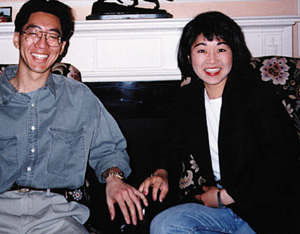
Lexington, Kentucky Sports Anchor Akemi Takei with brother Scott GS: How long did you work there? AT: My sophomore through senior years. GS: How did you get that internship? AT: My first intership was actually the summer after my freshman year in college with CBS news in LA. GS: How did you get that one? AT: One of the correspondents for CBS News is a family friend of ours. He helped me get in touch with the people I needed to talk to. One of the producers I worked with there had previously worked with a station in the Bay Area. GS: So it was through personal contacts. AT: Yes. GS: Did you work part time during your masters program? AT: No. PAGE 2 | PAGE 1 | 2 | 3 | 4 | 5 | 6 | 7 | 8 | 9 | 10 | 11 |
| ||||