
|
PERSONALITIES | FEATURES | NEWS
RISING FASTBALLER
 ark Chan Ho!"
"Park Chan Ho!" "Park Chan Ho!" The chant begins deep in the blue reserved seats high along the first base line on a clear April night at Dodger Stadium. The seats begin to tremble, the homemade banners are held high in the air and the swollen Corean contingent at tonight's game is pounding out its satisfaction. From foul pole to foul pole, they call out to the young pitcher: "Park Chan Ho!" "Park Chan Ho!" "Park Chan Ho!" Chan Ho Park, the Great Corean Hope, is on the mound against the Florida Marlins and here, in the middle of the third inning, he owns the hill. The 22-year-old right hander appears cool and confident as he faces the heart of the Florida lineup. Down go the Marlin batters, one by one, as if shot in the heart by Park's fastball. In the fifth inning, he begins to tire and is replaced by a relief pitcher although he still looks as if he could mow down a few more. Dodger manager Tommy Lasorda takes no chances. Effective as he is, Park is still relatively new to the Dodger's major league roster and even more unseasoned as a starter, one of five pitchers the Dodgers use to open a game. Park is pitching tonight because of an injury to starter Ramon Martinez, who could be back anytime. So Park holsters his weapon and takes his rest. Just being on a major league roster is an enormous victory for Park, the first Corean ever to play at this level. But it's been a roller coaster. Park was brought up to the Dodgers in 1994 right out of the major league amateur draft, when teams select new players from all over, players with no previous professional experience. Most of these draftees are first sent to a team's minor league clubs to gain more experience and training. Park was brought straight up to join the Dodgers at the major league level, "The Show," as the players call it. No Dodger had been brought straight up the majors since Sandy Koufax back in 1955. But it wasn't to be. At least not then. Park never lived up to his potential in 1994. Early the following season he was sent back down to play for the Dukes, the Dodger's minor league team in Alberquerque, New Mexico. He was brought back up to the majors in the latter part of the season when the Dodgers' fate had already been decided. He pitched in two separate games, once as a relief pitcher and once as a starter, showing promise in both games. |
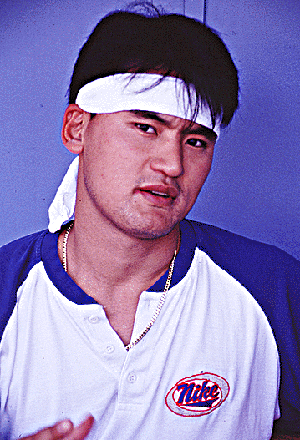
In the meantime the Dodgers had acquired Hideo Nomo, the "Tornado," a major league pitcher with Japanese experience, a vicious fastball and a delirious legion of fans in Japan and in the U.S. He was selected last year's "Rookie of the Year," the fourth Dodger in a row to earn the award. Comparisons were inevitable. With his fellow Asian teammate's fortunes rising quickly, Park had to be feeling enormous pressure as this season began. Even the Los Angeles Times ran a 2-page story just prior to the opening week of the season, detailing the amount of pressure the young pitcher was under. So he faced the upcoming season with a screaming fastball of his own, and the fingernails of his fans worn down to the nub. This was it. He had to make it this time--for himself, for his family in Kong Ju City and for South Corea, which had begun to closely follow his exploits. In fact, Corean TV was now broadcasting all his starts live back to an audience of 13 million in his homeland. His was a fame that spread throughout the league quickly and took root firmly in the Corean community. Visiting my local video store, I look up to see Park on the local news broadcast. The twentysomething Corean store manager gazes up at him. "He goes to church with my parents," he says coolly but proudly. PAGE 2
|
||||