

10 Asian Americans Pegged for Tech Breakthroughs in 2026
By Goldsea Staff | 01 Jan, 2026
These brilliant innovators in the fields of biotech, AI, nuclear engineering, quantum computing and materials sciences will drive important improvements in human life.
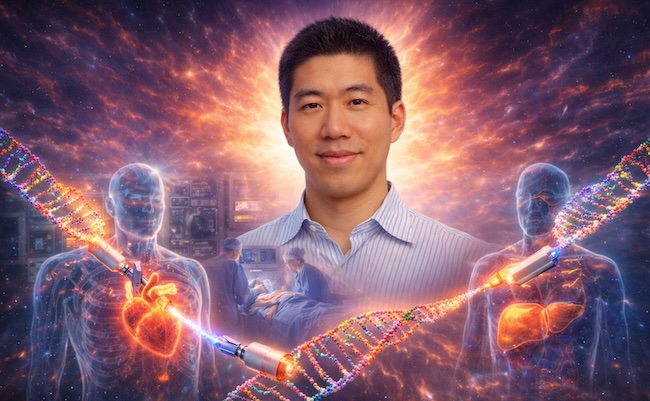
David Liu's work on DNA editing and delivery vehicles allow gene therapies to reach the correct organs, allowing gene therapies to go beyond research to save lives. (Image by ChatGPT)
This year's breakthroughs — many of them by leading Asian American pioneers — will see the convergence of the digital and physical worlds. Artificial intelligence will move beyond chatbots into physical space. Biotechnology will matures from discovery to clinical cure.

Yasir Arafat is scheduled to debut microreactors to provide power for data centers or small cities. (Image by ChatGPT)
Asian Americans have long been the backbone of the American research infrastructure. In 2026, they will emerge as visionary founders and lead scientists at the helm of the most consequential breakthroughs to create a world of convenience and abundance.
From the engineering of "spatial intelligence" to the quest for limitless clean energy through micro-reactors, these ten individuals are poised to reshape the human experience this year.

Fei-Fei Li's focus on spatiality as a critical AI capability is leading to more versatile robots for domestic and industrial uses. (Image by ChatGPT)
David Liu (Biotech and Molecular Biology)
As 2026 begins, David Liu remains a towering figure in the "search and replace" era of medicine. The Harvard professor and co-founder of Prime Medicine is currently overseeing the pivot of prime editing from laboratory marvel to life-saving clinical application.
Following his 2025 Breakthrough Prize, Liu’s research in 2026 is expected to yield the first comprehensive results from human trials targeting chronic genetic conditions like sickle cell disease and certain types of hereditary blindness. His "base editing" and "prime editing" technologies allow for precise DNA alterations without the dangerous double-stranded breaks associated with earlier CRISPR methods.
In 2026, his work on "delivery vehicles"—ensuring these editors reach the correct organs—is the breakthrough that will determine the scalability of genomic medicine.
Fei-Fei Li (Artificial Intelligence and Spatial Intelligence)
Known as the "Godmother of AI," Fei-Fei Li is spending 2026 demonstrating that the next frontier of intelligence isn't just language, but "spatiality."
Her startup, World Labs, having launched its multimodal world model "Marble" in late 2025, is now at the center of the robotics and AR/VR revolution. Li’s work addresses the "missing piece" of AI: the ability for machines to perceive, reason about, and interact with 3D environments as humans do.
In 2026, we expect to see World Labs integrate these spatial models into a new generation of "embodied AI" that can navigate complex domestic and industrial settings, effectively bridging the gap between digital brains and physical bodies.
Alexandr Wang (AI and National Defense Infrastructure)
As the CEO of Scale AI Alexandr Wang has become the architect of the United States' AI defense strategy.
In 2026, his focus is on the "sovereignty of data." With Scale AI valued at over $14 billion, Wang is leading the implementation of the Pentagon’s first comprehensive framework for testing and evaluating Large Language Models (LLMs) in high-stakes military environments. His 2026 breakthroughs are less about the "size" of models and more about their "verifiability."
By creating "ground truth" datasets for classified environments, Wang is ensuring that AI can be deployed safely in everything from autonomous logistics to real-time battlefield decision support, solidifying American leadership in the global AI arms race.
Yasir Arafat (Nuclear Engineering)
The quest for carbon-free, portable power has found a champion in Yasir Arafat, the Rohingya CTO of Aalo Atomics, (not to be confused with the chairman of the Palestinian National Authority by the same name).
A former lead for the MARVEL microreactor program at Idaho National Laboratory, Arafat is pushing for a historic milestone: achieving criticality for a commercial microreactor by July 4, 2026. His work focuses on "Aalo-1," a reactor design that prioritizes factory-based mass production over on-site construction.
If successful this year, Arafat’s breakthrough will demonstrate that nuclear energy can be scaled like a consumer product, providing 24/7 power to remote communities, data centers, and disaster zones without the massive footprints of legacy plants.
Zhenan Bao (Materials Science and Bio-electronics)
Stanford professor Zhenan Bao is entering 2026 at the peak of her decades-long quest to create "electronic skin."
Her breakthroughs in polymer chemistry have resulted in materials that are not only flexible and stretchable but also capable of transmitting sensory data directly to the human nervous system.
In 2026, the first advanced clinical prototypes of Bao’s synthetic skin are expected to be integrated into high-end prosthetics, allowing amputees to experience a nuanced sense of touch and temperature. This fusion of materials science and neurology represents the first true step toward "cyborg" integration that enhances, rather than just replaces, human biological function.
Feng Zhang (Biotech and CRISPR)
A pioneer of the CRISPR-Cas9 system, Feng Zhang’s 2026 research at the Broad Institute is focused on "rejuvenation."
Following a landmark study in late 2025 on using mRNA to program the liver to improve T-cell function, Zhang is now testing these "immune-rebooting" therapies in larger models. His breakthrough for 2026 lies in "compact" genome editing—using enzymes like NovaIscB that are one-third the size of traditional Cas9.
This small size allows for easier delivery into human cells, potentially unlocking cures for complex diseases like muscular dystrophy and providing a pathway to reverse some of the effects of biological aging.
Jerry Chow (Quantum Computing)
As an IBM Fellow and a primary architect of the IBM Quantum roadmap, Jerry Chow is the man leading the world into the "utility era" of quantum computing.
While the 1,121-qubit "Condor" chip set the stage, Chow’s 2026 focus is on quantum error correction and the "Starling" architecture. This year, his team is expected to demonstrate "logical qubits"—clusters of physical qubits that work together to cancel out errors—at a scale that makes quantum-classical hybrid algorithms commercially viable.
This breakthrough is essential for simulating new molecules for drug discovery and optimizing global supply chains in ways that classical supercomputers simply cannot.
Shirley Meng (Materials Science and Energy Storage)
Batteries are the bottleneck of the green transition, and Shirley Meng is the scientist breaking the glass.
As the Chief Scientist for the Argonne Collaborative Center for Energy Storage Science, Meng’s 2026 breakthroughs are centered on "anode-free" and "solid-state" battery architectures. By eliminating the liquid electrolyte in favor of solid-state conductors, Meng is paving the way for batteries that are significantly safer, denser, and faster to charge.
Her 2026 work on sodium-ion batteries—which use abundant salt rather than scarce lithium—could finally make grid-scale energy storage affordable for developing nations.
Ankur Jain (Biotech and Neurodegenerative Diseases)
At the Whitehead Institute and MIT, Ankur Jain is pioneering a new way to look at how cells organize themselves. His research focuses on "RNA phase separation"—the process where RNA molecules clump together into "gels" or droplets.
In 2026, Jain is expected to announce the first successful "small molecule" candidates that can safely dissolve these RNA aggregates in the brains of patients with ALS and Huntington’s disease. By treating these diseases as "material science" problems within the cell, Jain is opening a therapeutic window for conditions that have been considered death sentences for decades.
Dina Katabi (AI and Healthcare Monitoring)
MIT’s Dina Katabi is perfecting "The Invisibles"—AI-powered sensors that monitor human health using radio waves, without the need for wearables or cameras.
In 2026 her breakthroughs in generative AI for health sensing are being integrated into standard home healthcare systems. These sensors can "see" through walls to detect changes in gait, breathing patterns, and sleep quality, alerting doctors to the onset of Parkinson’s or heart failure months before a patient notices symptoms.
In 2026 Katabi’s work is shifting the healthcare paradigm from "reactive treatment" to "continuous, invisible prevention."
The Year of Realization
The common thread among these ten innovators is a move away from theoretical potential toward tangible implementation.
In 2026, "tech breakthroughs" are no longer just lines of code or laboratory curiosities; they are the power grids in our backyards, the sensors in our homes, and the very edits within our genetic code.
As these Asian American leaders drive these advancements, they are not only accelerating the pace of human progress but also ensuring that the technological future is built on a foundation of precision, sustainability, and human-centered design.
© 2026 by Asian Media Group Inc.
Recent Articles
- CXMT Wins $3 Billion Memory Supply Deal with Tencent
- Geely to Ship First Lotus EVs to Canada in July Under Carney-Xi Deal
- Soaring Bills Reshape How Businesses Choose Models
- Samsung, SK Hynix to Anchor $576 Billion AI-chip Drive to Cement Korea's Global Leadership
- S. Korea's 'Mega Projects' Center Around Chips, Data Centers and Robotics
- Trump’s Tariffs Aren’t Saving Jobs at Whirlpool’s Iowa Refrigerator Plant
- US Supreme Court Rebuffs Trump's Appeal in E. Jean Carroll Case
- S. Korean Exports Grow Fastest in Nearly 50 Years
- South Korean President to Unveil Massive AI and Chip Investment Drive
- Philippines Leads World in Solar Installs as Power Prices Soar