

10 Ships a Day Exit Strait of Hormuz Despite Signs of Aggressive Control by Iran
By Reuters | 20 May, 2026
Three supertankers bound for China and Korea exited with 6 million barrels of Mideast crude after waiting in the Gulf for more than two months via a transit route that Iran has ordered ships to use.
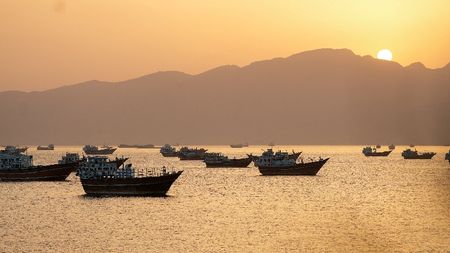
Vessels in the Strait of Hormuz, Musandam, Oman, May 18, 2026. REUTERS
Three supertankers were crossing the Strait of Hormuz on Wednesday carrying oil bound for Asian markets, after waiting in the Gulf for more than two months with 6 million barrels of Middle East crude on board, while another was entering, shipping data on LSEG and Kpler showed.
The ships are among a handful of supertankers exiting the Gulf this month via a transit route that Iran has ordered ships to use.
The U.S.-Israeli war on Iran which began on February 28 has severely curtailed shipping through the Strait of Hormuz, through which around one-fifth of the world's supply of oil and energy normally flows.
South Korean-flagged Very Large Crude Carrier (VLCC) Universal Winner, carrying 2 million barrels of Kuwaiti crude loaded on March 4, was exiting the strait following the departure of two Chinese tankers on Wednesday, the data showed. Kpler data showed the tanker is heading to Ulsan, where the country's largest refiner SK Energy is located, to discharge its cargo on June 9.
SK Energy declined to comment. A spokesperson for HMM, the owner and manager of the VLCC, could not be immediately reached for comment.
SHIPPING RISKS
Before the war began, shipping traffic through the strait averaged 125 to 140 daily passages, and 20,000 seafarers remain stranded inside the Gulf on board hundreds of ships.
Shipping traffic has averaged 10 vessels going into and out of the strait in recent days and has included cargo vessels and other ships such as chemical and liquefied petroleum tankers, with crude oil tankers still representing a small proportion of the total volume, according to Reuters analysis based on ship tracking data.
Around 10 ships crossed the strait in the past 24 hours and included small cargo ships and a chemical tanker crossing into the Gulf, according to data from Kpler and satellite analysis from data analytics specialists SynMax.
"The operating environment remains high risk based upon recent attacks on ships in the area," the U.S. Navy-led Joint Maritime Information Center said in a note on Tuesday.
"Multiple instances of aggressive hailing and assertive action by Iranian units have been noted in the last 48 hours."
Shipping industry associations on Wednesday issued new guidance for ships looking to sail through the strait, pointing to multiple navigational hazards, including the risk of being attacked, the threat of drones and mines but also unpredictable traffic congestion and "reduced military oversight".
"Hundreds of vessels remain unable to transit the Strait of Hormuz and, in the event of a return to more normal navigation conditions, the movement of all those vessels within the Strait could represent a considerable navigational hazard," the associations said in the guidance.
CHINESE TANKERS
Chinese-flagged VLCC Yuan Gui Yang loaded 2 million barrels of Iraqi Basrah crude on February 27, a day before the U.S.-Israeli war on Iran started, the data showed.
The vessel, chartered by Unipec, the trading arm of Asia's largest refiner Sinopec, which exited the strait earlier on Wednesday, is expected to reach Shuidong Port near Maoming city in southern Guangdong province on June 4 to discharge its cargo, according to the data.
Hong Kong-flagged VLCC Ocean Lily loaded 1 million barrels each of Qatari al-Shaheen and Iraqi Basrah crude between late February and early March, the data showed.
The vessel, owned by Chinese major Sinochem, is expected to reach Quanzhou Port in eastern Fujian province on June 5 to discharge its cargo.
Sinopec, Sinochem and Cosco Shipping, which own and manage Yuan Gui Yang, did not immediately respond to requests for comment.
Last week, VLCC Yuan Hua Hu exited the strait with 2 million barrels of Iraqi oil and headed for eastern China's Zhoushan Port.
Separately, Cypriot-flagged VLCC Grand Lady has entered the Strait of Hormuz with its transponder off, LSEG data showed. The empty tanker is anchored off Dubai, LSEG data showed. The tanker's manager Eastern Mediterranean Maritime could not be immediately reached for comment.
(Reporting by Florence Tan in Singapore, Kyu-seok Shim and Joyce Lee in Seoul, Jonathan Saul in London and Renee Maltezou in Athens; Editing by Jacqueline Wong, Lincoln Feast and Sharon Singleton)
Recent Articles
- Trump Continues Heavy-Handed Trash-Talking while Claiming Iran Talks Nearing Conclusion
- OpenAI to Open First Applied AI Lab Outside US in Singapore
- Alibaba Unveils New AI Chip in Push for Domestic Alternatives
- Gan-Z Are Unhappy About the Impact of AI in Their Lives
- Anthropic's Mythos AI Model Spurs Overblown Hacking Fears
- 10 Ships a Day Exit Strait of Hormuz Despite Signs of Aggressive Control by Iran
- Stellantis, Jaguar-Land Rover Explore Jointly Developing Vehicles in US
- Xi and Putin Unite in Criticism of US, but Fail to Clinch Big Gas Deal
- TJX Raises Annual Forecasts on Value Hunting by US Shoppers
- Drought and Rising Costs from Iran War Deepen Pain for US Farmers