

Airlines, Travel Industry Will Take Time to Recover
By Reuters | 08 Apr, 2026
The 14-day Iran ceasefire, even if made permanent, won't be able to reverse the damage sustained by the global oil industry from the 5-week Mideast conflict.
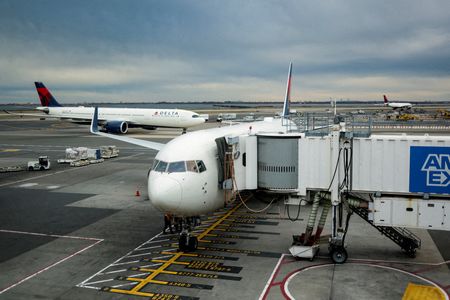
Delta Air Lines planes at John F. Kennedy (JFK) International Airport in New York City, U.S., November 18, 2025. REUTERS/Jeenah Moon/File Photo
U.S. President Donald Trump's two-week ceasefire with Iran is unlikely to provide immediate relief to the global aviation industry as it reels from its worst crisis in years, executives said on Wednesday, even as airline shares rallied after the deal.
Willie Walsh, director general of the International Air Transport Association (IATA), warned it would take months for jet fuel supply to recover even if Iran reopened the Strait of Hormuz, given disruptions to Middle East refining capacity.
Delta Air Lines forecast lower-than-expected profit for the second quarter and said it would cut capacity across the board to make up for the $2 billion in extra fuel costs it expects to book in the second quarter.
OIL PRICES DROP AFTER CEASEFIRE DEAL
Fuel is the second-largest expense for airlines after labour, typically accounting for about 27% of operating expenses.
Iran's closure of the Strait of Hormuz has choked supplies of jet fuel globally, and news of a ceasefire and the possibility of safe passage through the Strait sent airline stocks soaring.
Oil fell below $100 per barrel after Trump said he had agreed to a two-week ceasefire with Iran, subject to the Strait's immediate and safe reopening.
But comments from executives and experts across the industry highlight deepening pain for airlines facing a doubling of jet fuel prices and worries about constrained supplies.
Carriers across the world have been hiking fares, cutting flights, carrying extra fuel from home airports and adding refueling stops as the Middle East conflict squeezes supply.
Walsh told reporters that while he expected crude oil prices to fall, jet fuel costs were likely to remain slightly elevated due to the impact on refineries.
"If it were to reopen and remain open, I think it will still take a period of months to get back to where supply needs to be given the disruption to the refining capacity in the Middle East," Walsh said.
AIRLINE SHARES SURGE, BUT TOURISM RECOVERY WILL TAKE TIME
Jet fuel prices normally move in tandem with oil prices, but they have more than doubled since the Iran conflict, far outpacing a 50% rise in crude prices prior to the two-week ceasefire.
That has inflated costs, disrupted schedules, prompted airlines to cut routes and pushed the limits of what travelers will pay.
On Wednesday, Delta said it expects to pay about $4.30 a gallon for jet fuel in the June quarter, adding more than $2 billion to the price a year earlier.
Even so, global airline and travel stocks rose. Australia's Qantas Airways jumped more than 9%, Air New Zealand rose over 4%, Hong Kong's Cathay Pacific climbed 5% and while India's IndiGo rose 8%.
In Europe, travel operator TUI was up more than 12%, Wizz Air gained 10%, Air France-KLM climbed around 14%, and Lufthansa was up 11% by 1132 GMT, outperforming gains in European equity indexes. U.S. airlines rallied in premarket trading too.
While jet fuel supply disruption remains a risk, the ceasefire provided "a buying opportunity for quality airlines", analysts at Panmure Liberum said in a note.
STRANDED CRUISE SHIPS AND LONG RECOVERY FOR TOURISM
TUI said it was looking at options for its two cruise ships - "Mein Schiff 4" and "Mein Schiff 5" - which have been stranded in Abu Dhabi and Doha since the war began.
Skeleton crews are keeping the ships operational, according to the company. It will take at least four weeks to ready them for their next planned trips, depending on the route, weather, and operational conditions.
Even with travel through key transit hubs potentially reopening with a ceasefire, the Middle East's tourism industry - worth some $367 billion - will also take time to recover.
It could take months even in a best-case scenario, Oxford Economics economist Aaron Goldring said in a briefing.
"You basically have a tail of around seven months post ceasefire of sentiment impact," Goldring said, "with the perception of safety coming back quite gradually."
(Reporting by Lee Yi-Chin in Singapore and Julie Zhu in Hong Kong, Alessandro Parodi and Cian Muenster in Gdansk, Ilona Wissenbach in Frankfurt and Rajesh Kumar Singh in Chicago and Shivansh Tiwary in Bengaluru; Writing by Josephine Mason; Editing by David Holmes)
Articles
- Alexander Wang's Meta Superintelligence Lab Releases First AI Model
- Airlines, Travel Industry Will Take Time to Recover
- China's Teapots Seek Iranian Oil at Lower Prices
- Stellantis Aims to Develop Opel EV with China's Leapmotor
- Trump Sees China's Hand in Iran Ceasefire
- Why the Bond Market Won't Bounce Back to Pre-War Levels
- South Asia Growth to Slow to 6.3% in 2026 Says World Bank
- Pakistan Embraces Chinese Electric Motorbikes Amid Soaring Fuel Prices
- Brilliant Danhao Wang Dies of National Security
- Oil Slides Below $100, Stocks Soar As Trump Agrees to 2-Week Ceasefire