

Chip Queen He Tingbo Subverts Moore's Law to Overturn the Global Semiconductor Hierarchy
By H Y Nahm | 16 Jun, 2026
By putting Huawei muscle behind Tau Scaling Law, China's most respected chip executive leads a strategy that may overcome US efforts to impede her nation's AI advances.
For the past decade US policymakers have pursued an incredibly simple-minded strategy for preserving America's lead in artificial intelligence: deny China access to the world's most advanced chips and the tools needed to manufacture them.
The reasoning borders on the childish. If AI performance depends primarily on ever-more-powerful semiconductors fabricated using ever-smaller transistor geometries, controlling access to cutting-edge chip technology should slow China's progress by years, perhaps even decades.
If only the pathways of technological innovation were so simple! More than any other human, one woman understands its central fallacy.
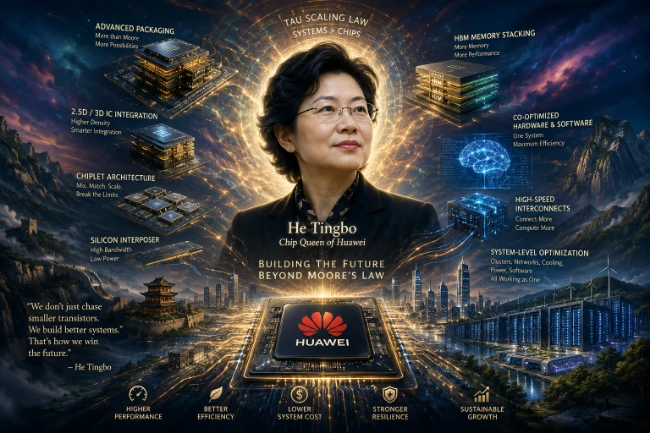
He Tingbo, the longtime head of Huawei's semiconductor operations and one of the most influential figures in China's technology sector. Often called China's "Chip Queen," He has become the architect of a strategy that aims not merely to survive US sanctions but to make them irrelevant.
Rather than competing directly with Nvidia, AMD, and TSMC in the race toward ever-smaller transistors, He and Huawei are investing heavily in an alternative vision of computing power. That vision revolves around what researchers increasingly call the Tau Scaling Law, a concept that could fundamentally reshape the economics of artificial intelligence.
If successful, it may accomplish something many experts once considered impossible: overturn the existing global semiconductor hierarchy.
The Woman behind China's Semiconductor Resilience
Outside China He Tingbo remains far less famous than Jensen Huang of Nvidia or Morris Chang of TSMC.
Inside China, however, she occupies near-legendary status.
Born in Jiangsu Province, He earned a master's degree in communications engineering before joining Huawei in the 1990s. She rose through the ranks to lead HiSilicon, Huawei's semiconductor design arm.
For years HiSilicon quietly became one of the world's most sophisticated chip designers. Its Kirin smartphone processors often rivaled those of Apple and Qualcomm. Huawei networking chips became critical to telecommunications infrastructure worldwide.
Then came the US sanctions.
Beginning in 2019, Washington effectively severed Huawei from access to advanced manufacturing services provided by TSMC. Many observers assumed Huawei's semiconductor ambitions were finished.
Instead, He led one of the most remarkable survival efforts in modern technology history. Huawei redirected enormous resources toward domestic semiconductor capabilities, advanced packaging, software ecosystems, networking infrastructure, AI accelerators, and alternative scaling approaches.
The result has been a steady stream of surprises. Despite severe restrictions, Huawei has repeatedly introduced increasingly capable AI chips and smartphones. The company has demonstrated an ability to innovate under conditions that many competitors would consider catastrophic.
That adaptability has begun paying dividends.
The Limits of Moore's Law
For more than half a century, the semiconductor industry relied on a simple formula. Shrink transistors.
Smaller transistors allowed more computing power, lower energy consumption, and lower costs. The trend became known as Moore's Law after Intel co-founder Gordon Moore.
Moore's Law transformed modern civilization. Smartphones, cloud computing, artificial intelligence, and the internet all emerged from the relentless miniaturization of semiconductor devices.
But physics is becoming an increasingly stubborn obstacle. Modern leading-edge chips already contain features measured in single-digit nanometers. Engineers are approaching atomic-scale limits. Manufacturing costs have exploded.
A state-of-the-art fabrication facility now costs tens of billions of dollars. Advanced EUV lithography machines cost hundreds of millions each. Each new generation of process technology delivers smaller gains while demanding larger investments.
The industry isn't running out of innovation. It is running out of easy innovation.
That's where Tau Scaling enters the picture.
What Is Tau Scaling Law?
Traditional semiconductor progress focuses on making individual chips better. Tau Scaling focuses on making systems better.
Instead of relying entirely on transistor shrinkage, Tau Scaling seeks performance gains through larger computing clusters, improved interconnects, software optimization, memory architecture, model efficiency, and system-level integration.
The concept derives from observations emerging from large-scale AI training. Researchers have increasingly found that intelligence gains can come not only from better chips but also from more effective use of available compute resources.
Network architecture matters. Memory bandwidth matters. Inter-chip communication matters. Data quality matters. Algorithm efficiency matters. Training strategies matter.
In many AI workloads, system-level improvements can generate gains that rival or exceed those produced by shrinking transistors. The practical implication is profound. A nation denied access to the absolute best chips may still remain competitive by optimizing everything surrounding those chips.
That possibility directly challenges the assumptions underlying many export-control policies.
Huawei's Alternative Path
Huawei has become perhaps the most ambitious practitioner of this philosophy. The company understands that it may remain behind Nvidia in raw chip performance for years. Instead of attempting to close every gap simultaneously, Huawei is building an ecosystem designed to compensate for those disadvantages.
Its Ascend AI processors are increasingly deployed in large clusters. Its networking expertise provides high-bandwidth connections between processors. Its software stack seeks to reduce dependence on foreign platforms. Its cloud infrastructure integrates hardware and software more tightly than many competitors.
Most importantly, Huawei is pursuing advanced packaging and cluster-level optimization at enormous scale. This strategy resembles the philosophy that powered China's broader manufacturing rise. Rather than dominating every component individually, optimize the entire system.
When applied to AI, that approach may prove surprisingly effective.
The Packaging Revolution
One reason Tau Scaling is gaining attention involves advances in semiconductor packaging. For decades, packaging was viewed as a secondary consideration. The real action occurred inside the chip.
Today, packaging increasingly determines overall system performance. Advanced packaging technologies allow multiple chips to function as a unified system. Memory can be positioned closer to processors. Data movement can be accelerated dramatically.
The result is that engineers can continue achieving meaningful performance gains even when transistor scaling slows. This trend benefits companies facing manufacturing constraints. A firm that cannot produce the world's smallest transistors may still achieve competitive performance through superior integration and packaging.
China has invested heavily in this area. Huawei, under He's leadership, has emerged as one of its most aggressive proponents. In some respects, advanced packaging may become as important to future computing as transistor scaling was to previous generations.
Taking on the Nvidia Empire
None of this means Nvidia is about to lose its crown. Far from it. Nvidia enjoys enormous advantages. Its CUDA software ecosystem has become deeply embedded across AI research and industry. Developers know its tools. Cloud providers have standardized around its hardware. Customers trust its roadmap.
The company benefits from years of accumulated software, developer support, and ecosystem momentum. Those advantages are often more important than raw hardware specifications. Many technically superior products have failed because they lacked ecosystem support. Nvidia understands this better than anyone. That's why Jensen Huang increasingly describes Nvidia not as a chip company but as a computing platform company.
Huawei faces a similar challenge. Building competitive hardware is difficult. Building a competitive ecosystem is even harder. Yet Huawei's progress suggests that the challenge isn't insurmountable.
The Forseeable but Unintended Consequences of Sanctions
Ironically, US restrictions may have accelerated some of China's most important innovations.
Before sanctions, Huawei could simply purchase leading-edge manufacturing services and focus on conventional chip development. After sanctions, that option largely disappeared. Necessity forced experimentation.
Chinese firms began investing more heavily in alternative architectures, packaging technologies, domestic equipment, software ecosystems, and system-level optimization. Some of these efforts will fail. Others may produce breakthroughs that would never have occurred under normal market conditions.
History offers numerous examples. Japan's auto industry developed fuel-efficient vehicles partly in response to resource constraints. The Soviet space program achieved remarkable accomplishments despite technological disadvantages in several areas. Israeli defense firms often innovated around limitations imposed by geography and resources.
Constraints frequently become catalysts for creativity. He Tingbo appears determined to turn sanctions into precisely that kind of catalyst.
The Ultimate Battle: Economics, not Technology
Ultimately, the future semiconductor race may hinge less on transistor size than on economics. AI deployment is becoming astonishingly expensive. Training advanced models requires enormous investments in hardware, energy, cooling, networking, and data centers.
As costs rise, efficiency becomes increasingly valuable. A system delivering 90% of Nvidia's performance at half the cost could prove highly attractive. A system delivering 80% of the capability at one-third the cost could become irresistible in many markets.
This is where Huawei's strategy becomes particularly dangerous for competitors. The company doesn't necessarily need to beat Nvidia on every benchmark. It only needs to offer enough capability at an attractive enough price.
China's domestic market alone may provide sufficient scale to support that effort. From there, Huawei could gradually expand into other regions willing to prioritize affordability over absolute performance leadership.
A Contest Just Getting Started
Predictions of imminent Chinese semiconductor dominance remain premature. So do predictions of permanent Chinese inferiority.
The reality is considerably more nuanced. The traditional semiconductor model centered on Moore's Law undeniably favors companies such as Nvidia, TSMC, Intel, AMD, and their supply-chain partners. But that model is evolving.
As transistor scaling slows, system architecture, packaging, networking, software, and cluster optimization become increasingly important. These are areas where Huawei possesses substantial strengths.
He Tingbo's significance lies not merely in managing Huawei's semiconductor operations. Her importance stems from recognizing earlier than many competitors that the rules of the game may be changing. The world's semiconductor hierarchy was built during an era when transistor scaling dominated everything else. The next era may look very different.
If Tau Scaling proves capable of delivering sustained AI gains through system-level innovation, the winners of the coming decade may not simply be the firms with the smallest transistors. They may be the firms that best integrate chips, software, networks, memory, packaging, and artificial intelligence into cohesive computing systems. That's the future He Tingbo appears to be betting on.
And if she's right, the campaign to slow China's AI rise through semiconductor restrictions may ultimately accelerate the emergence of a new technological order—one in which the Chip Queen's greatest achievement isn't catching up to the existing hierarchy, but rendering it obsolete.
© 2026 by Asian Media Group Inc.
Recent Articles
- US Senate Narrowly Blocks New Bid to Rein in Trump War Powers
- BYD Ramps up Battery Production in Brazil
- Intel Begins Chip Production with New Fabrication Process
- 'Wingman' Drone Key Piece of EU's Defense Self-Reliance
- Keiko Fujimori Edges Ahead in Brutal Contested Vote Count
- Chip Queen He Tingbo Subverts Moore's Law to Overturn the Global Semiconductor Hierarchy
- Only 30% of Americans Consider the US the World's Greatest Country
- US Spends $25,000 a Month to Store Unusable Contraceptives Stuck in Belgium
- AI Optical Parts Maker Zhongji Innolight Eyes $7 Billion Hong Kong Listing
- US-Iran Peace Deal Kicks the Can Down the Road