

How Min Kao Brought GPS Navigation to the World
By Goldsea Staff | 11 Feb, 2026
A Taiwanese immigrant co-founded Garmin and led the company to become the world's leading provider of GPS navigation products.
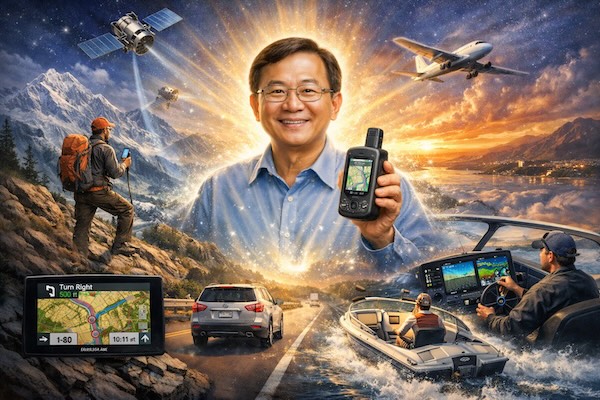
(Image by ChatGPT)
In the early 1990s navigation was pulling over to check a Thomas Brother map book. Min Kao saw a future where satellites would guide travelers anywhere on Earth. Then the Taiwanese-born engineer and entrepreneur set about to create the GPS revolution.
As co-founder and longtime leader of Garmin, Kao transformed GPS technology from a military tool into an indispensable consumer product that changed how billions of people navigate the world.
Min Kao's journey was born in 1949 in Zhushan, Taiwan, He grew up in modest circumstances during a period of rapid modernization in Taiwan. His early aptitude for mathematics and science pointed toward an engineering career, but his ambitions extended beyond Taiwan's borders. In the early 1970s Kao decided to pursue graduate education in the United States, joining the wave of talented Asian students who would reshape American technology and innovation.
Kao earned a master's and a doctorate in electrical engineering from the University of Tennessee in 1977, specializing in the emerging field of digital signal processing. The timing proved fortuitous. The late 1970s marked the dawn of the digital age, and Kao's expertise positioned him at the forefront of revolutionary changes in electronics and communications.
After graduation, Kao spent more than a decade working for major technology and defense companies, including King Radio Corporation and later at Allied Signal where he gained crucial experience in avionics and navigation systems.
Garmin's birth traces back to 1989 when Kao partnered with Gary Burrell, an engineer he had worked with at Allied Signal. Both men recognized an extraordinary opportunity emerging from a strategic shift in GPS technology. The Global Positioning System, developed by the US Department of Defense and fully operational by the mid-1980s, had been restricted primarily to military applications. However, following Korean Air Lines Flight 007's tragic downing in 1983 after straying into Soviet airspace, President Ronald Reagan declared that GPS should be available for civilian use.
Kao and Burrell understood that civilian GPS access would unlock transformative possibilities. They founded their company in Lenexa, Kansas, combining their first names to create "Garmin." While many entrepreneurs might have chosen the established tech hubs of California or Massachusetts, Kao appreciated Kansas's lower costs, strong work ethic, and strategic central location. This decision reflected Kao's pragmatic, engineering-minded approach to business—focusing on fundamentals rather than following trends.
The early years required extraordinary perseverance. Developing consumer GPS receivers entailed solving complex technical challenges. The devices needed to be small enough for portable use, affordable for average consumers, and simple enough for non-technical users—all while maintaining accuracy and reliability. Kao led Garmin's engineering efforts with meticulous attention to detail, personally involving himself in product design and development. His technical expertise proved invaluable as the small team worked to miniaturize components, optimize battery life, and create intuitive user interfaces.
Garmin's first product, the GPS 100, launched in 1990 as a marine navigation device. Priced at around $2,500, it was expensive but found a ready market among boaters who recognized the revolutionary advantage of satellite navigation over traditional methods. The GPS 100's success validated Kao's vision and provided capital for expansion. Throughout the 1990s, under Kao's technical leadership and Burrell's business acumen, Garmin systematically expanded into new markets: aviation, automotive, outdoor recreation, and eventually consumer handheld devices.
Kao's leadership philosophy blended immigrant determination with engineering discipline. Colleagues describe him as intensely focused on product quality and customer satisfaction rather than short-term profits. This approach sometimes put Garmin at odds with Wall Street's quarterly expectations, but Kao remained convinced that superior products would win long-term loyalty.
He invested heavily in research and development, typically allocating a higher percentage of revenue to R&D than competitors. This commitment to innovation allowed Garmin to maintain its technological edge even as larger companies entered the GPS market.
The early 2000s brought Garmin's greatest commercial success. The company's automotive GPS navigators became must-have accessories for drivers worldwide. Devices like the StreetPilot and later the nüvi series combined GPS technology with digital mapping, turn-by-turn voice directions, and touchscreen interfaces. These products transformed driving, making it possible for anyone to navigate confidently in unfamiliar places without stopping to check maps or ask for directions. At its peak, Garmin held dominant market share in portable navigation devices, with annual revenues exceeding $3 billion.
Kao's success reflected both technical brilliance and astute business judgment. When Garmin went public in 2000, Kao became one of the wealthiest Taiwanese-Americans. Kao maintained a relatively low public profile unlike many successful tech entrepreneurs.
He avoided publicity and focused relentlessly on Garmin's products and people. He built a corporate culture emphasizing engineering excellence, vertical integration (Garmin manufactured many components in-house), and long-term thinking.
The late 2000s brought Garmin's greatest strategic challenge: the smartphone. When Apple introduced the iPhone in 2007 with integrated GPS and free navigation apps, many analysts predicted Garmin's demise. The company's stock plummeted as investors expected smartphones to obsolete standalone GPS devices.
Lesser leaders might have panicked, but Kao showed strategic flexibility. Rather than fighting smartphones head-on, he directed Garmin to pivot toward specialized applications where dedicated devices offered advantages over phones: marine electronics, aviation instruments, fitness trackers, and outdoor recreation equipment.
This diversification strategy proved successful. Garmin became the leading provider of GPS devices for serious runners, cyclists, and outdoor enthusiasts through its Forerunner and Fenix product lines. The company's marine and aviation divisions grew into major profit centers, providing sophisticated navigation and communication systems for boats and aircraft. By focusing on professional and enthusiast markets where specialized hardware outperformed smartphone apps, Garmin not only survived but thrived in the post-smartphone era.
Kao served as Garmin's CEO until 2012 and remained executive chairman until 2022, providing continuity and strategic vision for over three decades. His leadership transformed a two-person startup into a global corporation employing over 18,000 people with operations on every continent. Garmin's products have touched billions of lives, making navigation accessible and reliable for drivers, pilots, sailors, hikers, and athletes worldwide.
Beyond business success, Kao has been a generous philanthropist, particularly supporting education and healthcare. He and his wife have donated tens of millions of dollars to the University of Tennessee, where Kao earned his doctorate, and various hospitals and medical research institutions. These contributions were Kao's way of showing appreciation for the educational opportunities that enabled his success and his desire to help others achieve similar advancement.
Today, when we casually check our phones for directions or use GPS watches to track our runs, we benefit from Min Kao's vision and determination. He didn't invent GPS technology itself, but he made it accessible, reliable, and useful for ordinary people. In doing so, Kao helped create the foundation for our modern world of location-based services, from ride-sharing apps to delivery tracking to emergency response systems.
© 2026 by Asian Media Group Inc.
Recent Articles
- Google Limits Meta’s Use of Its Gemini AI Models
- Key Volkswagen Shareholder Pitches Producing China Models in Germany
- S. Korea's Early World Cup Exit Triggers 'Utterly Baffled' Tirade by President
- Anthropic Allowed to Release Mythos AI Model to 'Tusted' US Organizations
- Apple Seeks Approval to Buy from Blacklisted Chinese Company to Ease Memory Crunch
- China's Industrial Profits Stay Resilient on Factories, Exports
- Meet the Teen Who Undertook a 7-Continent Solo Flight Against Cancer
- Getting Fit Pt. 2 - Raising Our Floor
- South Korea Survives World Cup Scare, Advances to Round of 32
- Why Asian-White Marriages Suffer Multiples the Disruption Rates of Asian-Asian Marriages