

Why Asian-White Marriages Suffer Multiples the Disruption Rates of Asian-Asian Marriages
By Kavya Anand | 28 Jun, 2026
The high disruption rates reflect more cultural, familial or social stresses than are typical in Asian-Asian marriages.
The most striking thing about divorce data on Asian American marriages isn’t simply that interracial marriages face higher risks of breakup. It’s how wide the gap can be between Asian-Asian marriages and Asian-White marriages when researchers break out the pairings.
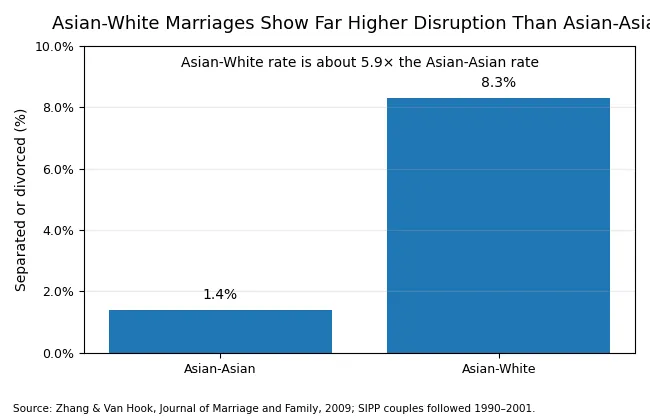
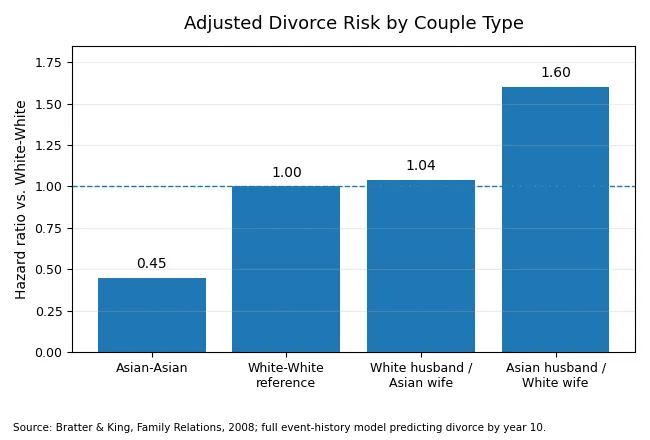
One widely cited study using Survey of Income and Program Participation data found that Asian-White couples had a separation-or-divorce rate of about 8.3%, while Asian-Asian couples were far lower. Another line of research, using event-history models of divorce by the 10th year of marriage, found that Asian husband/White wife marriages were 59% more likely to divorce than White/White marriages, while White husband/Asian wife marriages were only slightly more likely to divorce than White/White couples. In the same model, Asian-Asian marriages had far lower divorce risk than the White/White reference group.
That combination of findings points toward a difficult but important conclusion: Asian interracial marriages, especially Asian-White marriages, appear to face pressures that Asian-Asian marriages often don’t. The data don’t prove exactly what those pressures are. But they do suggest that cultural fit, family support, racial expectations and the social meaning of the husband-wife pairing may all matter more than polite society likes to admit.

The first caveat is that researchers don’t always use “divorce rate” in the casual sense. Some studies measure whether a couple separated or divorced during a follow-up period. Others estimate the hazard of divorce by the 10th year of marriage. Still others compare broad categories like Asian-Asian or Asian-White without telling us whether the Asian spouses are Chinese, Korean, Filipino, Indian, Vietnamese, Japanese or from another Asian background.
That matters because “Asian-Asian” can hide a lot. A Chinese American married to another Chinese American is not the same pairing as a Korean American married to a Vietnamese American or an Indian American married to a Filipino American. The US data generally aren’t rich enough to separate all those groups cleanly, at least not with large enough samples to make reliable divorce estimates. So the best national evidence usually compares broad race pairings, not detailed ethnic-national combinations.
Even with that limitation, the broad pattern is hard to ignore. Asian-Asian marriages look unusually stable. Asian-White marriages look much less stable than Asian-Asian marriages, even if they don’t always look worse than White-White marriages. That distinction is important. The “problem” may not be that Asian-White marriages are uniquely doomed. It may be that Asian-Asian marriages are unusually durable.
Why might that be?
The most obvious explanation is shared cultural infrastructure. Marriage isn’t just a private romance between two people. It’s also a merger of families, habits, rituals, expectations and unspoken rules. Asian-Asian couples may be more likely to share assumptions about filial duty, respect for parents, family gatherings, food, holidays, child-rearing, education, savings, elder care and the meaning of sacrifice. Even when two Asian spouses come from different ethnic backgrounds, they may still have more overlapping expectations than an Asian spouse and a White spouse.
That doesn’t mean Asian-Asian marriages are automatically harmonious. Anyone who has seen two immigrant families negotiate wedding customs, money, religion or in-law boundaries knows better. But shared reference points can reduce the number of issues that must be explained from scratch. A spouse who already understands why parents expect frequent visits, why academic pressure feels normal, why food and language matter, or why sending money to relatives abroad may not be optional has less translating to do.
In Asian-White marriages, the Asian spouse may have to explain not only personal preferences but an entire family system. That can become exhausting. A White spouse may be loving and well-intentioned but still baffled by expectations that feel intrusive, hierarchical or overly demanding. Meanwhile, the Asian spouse may feel torn between a spouse who wants more autonomy and parents who expect more obligation. Over time, that conflict can become less about “culture” in the abstract and more about countless everyday fights: where to spend holidays, how often to visit parents, how much to save, how much help to give relatives, what language children should learn, and how much authority grandparents should have.
Family acceptance is another likely factor. Interracial couples have become far more common and socially accepted than they were a few generations ago, but acceptance isn’t evenly distributed. Some Asian families still view marrying White as a loss of heritage, language or family continuity. Some White families may be welcoming on the surface while still carrying stereotypes about Asian spouses. Even subtle disapproval can weaken a marriage if it reduces the couple’s sense of being surrounded by allies.
This is where the gender pattern becomes especially revealing. The classic Bratter and King study didn’t find the same risk for every Asian-White combination. The higher risk was concentrated in Asian husband/White wife marriages. White husband/Asian wife marriages had divorce risk much closer to White/White couples.
That gender split suggests that society may still react differently depending on which spouse is Asian and which is White. White husband/Asian wife pairings have long been more common and, for better or worse, more culturally familiar in the US. Asian husband/White wife pairings have often violated older racial and gender expectations more directly. Asian men have historically been stereotyped as less masculine or less desirable, while White women have been treated as racially privileged symbols of mainstream American femininity. A couple that crosses those expectations may face a different kind of scrutiny.
That doesn’t mean strangers are constantly harassing these couples. The stress may be subtler. It can show up in jokes, stares, family discomfort, sexual stereotypes, assumptions about power, or the sense that the couple is always being interpreted by others. A marriage can survive that, of course. Many do. But repeated outside pressure can magnify ordinary marital tensions.
Selection effects may also play a role. People who intermarry may differ from those who marry within their group in ways that affect divorce risk: age at marriage, prior marriage, cohabitation history, nativity, education, region, family background or religiosity. Some interracial couples may be more independent from their families to begin with. That independence can be a strength, but it can also mean less family support when the marriage hits a hard patch.
That point is crucial because the raw figures don’t necessarily prove that interracial marriage itself causes divorce. A later study by Zhang and Van Hook argued that once couple characteristics are considered, interracial marriage per se doesn’t always show an independent divorce penalty. In plain English, the risk may come partly from who enters these marriages, where they live, how old they are, whether they’ve been married before and how much social support they have — not simply from racial difference itself.
Still, the Asian-Asian comparison remains powerful. If Asian-Asian marriages are much more stable, and Asian-White marriages are many times more likely to separate or divorce in descriptive data, something about shared background or shared community appears to be doing real work. It may not be ethnicity alone. It may be a bundle of traits correlated with ethnicity: immigrant generation, family structure, educational norms, social networks, economic habits and expectations about staying together even during unhappy periods.
That last point deserves attention. Lower divorce rates don’t always mean happier marriages. They may reflect stronger commitment, better compatibility and family support. But they may also reflect stigma, pressure to endure, concern about children, financial dependence, immigration status or the belief that divorce brings shame on the family. Asian-Asian marriages may be more stable partly because spouses are more compatible — but also partly because they face stronger incentives not to leave.
So the data shouldn’t be read as a moral ranking. Asian-Asian marriages aren’t automatically better, and Asian-White marriages aren’t automatically weaker. The numbers are population-level patterns, not predictions for any couple. A loving Asian-White couple with strong communication, supportive families and shared values may be far healthier than an Asian-Asian couple trapped in resentment. But population patterns still matter because they show where stresses tend to accumulate.
For Asian Americans, the lesson is not “don’t marry out.” That would be crude and wrong. The better lesson is that interracial marriage requires more deliberate preparation than romance alone. Couples need to talk early and honestly about parents, holidays, children, racial identity, money, gender roles, elder care, religion, language, food, where to live and what kind of extended-family involvement they can tolerate. These aren’t side issues. They’re often the very substance of married life.
Families also need to understand their own role. Parents who treat an interracial spouse as a temporary outsider may help create the very distance they fear. White families that exoticize an Asian spouse or dismiss the importance of Asian culture can do similar harm. Supportive families don’t need to erase differences. They need to give the couple enough room and respect to build a shared culture of their own.
The most important takeaway is that Asian interracial divorce patterns aren’t just about personal chemistry. They reflect the social environment surrounding the marriage. Shared culture can stabilize a marriage. Family approval can stabilize a marriage. Social acceptance can stabilize a marriage. When those supports are weaker, the marriage has to generate more of its strength internally.
That’s why the gap between Asian-Asian and Asian-White disruption rates is so revealing. It suggests that Asian-Asian marriages may benefit from a dense web of cultural familiarity and social reinforcement, while Asian-White marriages often have to build that web from scratch. Some couples manage that beautifully. Others discover too late that love can start a marriage, but culture, family and social support help keep it alive.
Key source notes: NCHS reported that after 10 years, interracial first marriages had a 41% chance of disruption versus 31% for same-race first marriages, while also noting that specific pairings were limited by small sample sizes. (CDC Stacks) Bratter & King’s full model reported an adjusted hazard ratio of 0.45 for Asian/Asian marriages, 1.04 for White husband/Asian wife marriages and 1.60 for Asian husband/White wife marriages, with White/White as the reference. Their discussion also states that Asian husband/White wife couples were 59% more likely to divorce than White/White couples, while White husband/Asian wife couples were only 4% more likely. (healthymarriageinfo.org) Zhang & Van Hook’s study found Asian-White couples had about 8.3% separated/divorced in SIPP follow-up data and concluded the elevated risk did not consistently prove an “interracial marriage per se” penalty after controls. (pmc.ncbi.nlm.nih.gov)
© 2026 by Asian Media Group Inc.
Recent Articles
- Google Limits Meta’s Use of Its Gemini AI Models
- Key Volkswagen Shareholder Pitches Producing China Models in Germany
- S. Korea's Early World Cup Exit Triggers 'Utterly Baffled' Tirade by President
- Anthropic Allowed to Release Mythos AI Model to 'Tusted' US Organizations
- Apple Seeks Approval to Buy from Blacklisted Chinese Company to Ease Memory Crunch
- China's Industrial Profits Stay Resilient on Factories, Exports
- Meet the Teen Who Undertook a 7-Continent Solo Flight Against Cancer
- Getting Fit Pt. 2 - Raising Our Floor
- South Korea Survives World Cup Scare, Advances to Round of 32
- Why Asian-White Marriages Suffer Multiples the Disruption Rates of Asian-Asian Marriages