

China Alarmed by Bernanke's QE3 Hint
By wchung | 20 Jun, 2026
Scaring China: A possible third round of quantitative easing would worsen China's soaring inflation rate.
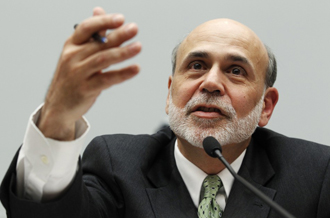
Fed Chairman Ben Bernanke's testimony before the House Financial Services Committee on Wednesday, July 13, 2011 was seen as opening the door to a QE3.
Fed Chairman Ben Bernanke’s testimony Wednesday before the House Financial Services Committee is sending ripples of alarm through China’s central planners by raising the possibility of a third round of quantitative easing.
“The possibility remains that the recent economic weakness may prove more persistent than expected and that deflationary risks might re-emerge, implying a need for additional policy support,” Bernanke said.
His remarks were taken as a signal of a possible third round of quantitative easing (QE3) in addition to the first round of $1.7 trillion in late 2009 and a second round of $600 billion in late 2010. China fears that injecting more liquidity into the U.S. financial system could feed the influx of capital into China, aggravating inflation as well as potentially lowering the value of its $3.2 trillion in foreign exchange holdings, mostly in dollars.
“If the Fed continues to print more money, it will drag China into a protracted war to limit liquidity and tame inflation,” said Lu Zhengwei, chief economist with Industrial Bank Co Ltd. ”It will be a very bad news for emerging countries.”
China’s consumer inflation of 6.4 percent in June, a 3-year high, is partly blamed by analysts on U.S. quantitative easing measures which drove global capital into developing markets, especially China.
Even the possibility of another liquidity injection could raise global commodity prices. Crude-oil futures finished higher Wednesday after Bernanke’s comments. Rising prices force emerging economies like China, India and Brazil to pay more for imported commodities, adding to inflationary pressures.
That would force such nations to maintain a tight-money policy by raising interest rates and bank reserve requirements.
A QE3 would also cause the yuan to appreciate faster against the dollar, noted Cao Fengqi, director of the Research Center for Finance and Securities at Peking University.
Another easing would produce another flood of dollars, lowering its value and threatening the value of China’s dollar-denominated foreign exchange stockpile.
“The primary task for China is to control consumer prices and maintain steady and fast economic growth (to counter any external shocks),” Cao said.
Bernanke’s hint of a QE3 could also be a strategy to pressure lawmakers to agree on raising the U.S. debt ceiling before the August 2nd deadline, analysts said. President Barack Obama and GOP lawmakers are locked in last-minute negotiations to prevent a default on U.S. treasuries.
Chinese rating agency Dagong Global Ratings Co Ltd on Thursday put the U.S. sovereign credit ratings on a negative watch list due to the rising debt.
The current political and economic situation had left little room for tax increases while it remains difficult to reduce military and welfare spending.
The U.S. national debt could swell to 124 percent of GDP in 2015, and the federal government would have to raise the debt limit by $5.5 trillion, Dagong said.
Dagong downgraded US ratings from AA to A+ on Nov 9, 2010 after the US government announced the second round of quantitative easing.
© 2026 by Asian Media Group Inc.
Recent Articles
- Trump Unveils Gifted Qatari 747 As Addition to Air Force One Fleet
- New Bangladesh Premier to Seek Investments, Jobs in China, Malaysia
- Charles Schwab Working with Cboe to Enter Prediction Market
- Mexico's Love Affair with All Things Korean — Until Thursday's Kickoff
- The Making of a Striking Tiger
- Japan's World Cup Prospects Brighter Than Their Single Group Point Might Suggest
- International Stars in the Red Devils' Lineup Suggests a Deep World Cup Run for S. Korea
- Italy's Meloni Says Trump 'Totally Invented' Story That She Begged Him for Photo
- Lebanon Ceasefire Agreed After US-Iran Talks in Switzerland Scrapped
- Qantas Bets on Sleep and Light Science to Sell 20-Hour Flights