

Nvidia Is Rare Tech Giant With Founders' Kids in Executive Posts
By Goldsea Staff | 26 Mar, 2026
Jensen Huang and Chris Malachowsky buck Silicon Valley norms in being founders of tech giants with offspring working at the company.
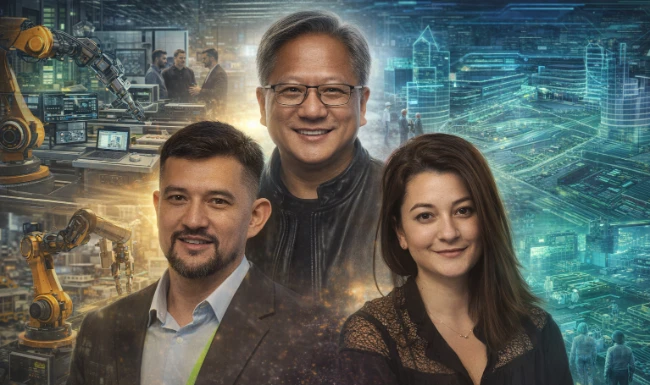
(Image by Copilot)
Silicon Valley has long cultivated a peculiar dynastic norm — one defined not by bloodlines, but by meritocracy, or at least its overt observance.
The children of tech's founding generation have, almost without exception, built careers far from the companies that made their families wealthy. Bill Gates' daughters aren't running product lines at Microsoft. Steve Jobs' children didn't inherit Apple. Larry Page's and Sergey Brin's kids aren't writing algorithms at Google. The unwritten rule has held remarkably firm: when you build one of the world's most valuable companies, you don't hand pieces of it to your offspring.
Prevailing Conditions Militate Against Nepotism
That norm has stuck for good reasons. For one, many of tech's biggest founders remain active in their companies well into their fifties and sixties. Few have reached the succession phase that triggers family-business thinking in older industries.
Beyond the industry's relative youth is its culture. Silicon Valley has always distinguished itself by rejecting the dynastic logic of, say, Wall Street or manufacturing. The founding mythology of tech is explicitly meritocratic — the garage, the dorm room, the Denny's breakfast booth — and placing a founder's child into a senior role cuts against that self-image in ways that make public companies and their shareholders deeply uncomfortable.
Boards don't love it. Employees don't love it. And savvy founders, even those who've accumulated staggering wealth, understand that nothing erodes trust in an institution faster than visible nepotism.
There's also a simpler explanation: many tech founders, particularly immigrants who built companies from nothing, raised their children to deliberately find their own identities. They didn't want second-generation entitlement. They wanted their kids to struggle a little, to build something, to earn it. The result has been a generation of tech heirs who've become doctors, artists, philanthropists, and investors — almost anything but employees at mom's or dad's firm.
Nvidia Exception
Which is what makes Nvidia so striking. While the rest of Silicon Valley was quietly following the unwritten rule, Nvidia was quietly breaking it.
The world's most valuable semiconductor company, the AI era's defining hardware maker, has not only employed the children of its chief executive Jensen Huang — it's also employed at least one child of co-founder Chris Malachowsky, the company's long-serving senior technical executive.
Add in the son of board director Aarti Shah, plus a broader culture in which executives' children have completed internships, and what's emerged at Nvidia isn't just an exception to Silicon Valley's dynastic avoidance — it's a counter-culture within a counter-culture.
Malachowsky himself is one of the most understated figures in tech history. He co-founded Nvidia with Huang and Curtis Priem at a Denny's in San Jose in 1993, has worked there ever since, and today holds the title of Nvidia Fellow — a senior technical designation that reflects decades of contribution to the company's core engineering. Unlike Huang, whose leather-jacket ubiquity has made him one of the most recognizable executives in the world, Malachowsky rarely courts attention. He still lives in the same Silicon Valley house he bought in 1993, though it's now worth around $8 million, and he's channeled much of his wealth into philanthropy, including a $40 million gift to the University of Florida that put his name on the Malachowsky Hall for Data Science and Information Technology.
His son works at Nvidia, but neither the company nor the family has made his specific title or compensation package public, and the younger Malachowsky's role hasn't drawn the scrutiny his co-founder's children have — perhaps because Huang's children occupy a far more visible position in the company's orbit.
Madison and Spencer Huang
Jensen Huang's two children, Madison and Spencer, came to Nvidia by routes that seem deliberately designed to insulate them from charges of parachuting in.
Spencer, the eldest, studied international marketing and cultural studies at Columbia College Chicago, a school known for its focus on arts and media. After graduating, he went back to Taipei to study Mandarin for a year — reportedly at his father's suggestion — and eventually opened a cocktail bar called R&D Cocktail Lab, which Forbes ranked among the top 50 bars in Asia in its first year. He ran it for nearly eight years before closing it in 2021.
Madison, meanwhile, studied culinary arts and enrolled in Le Cordon Bleu, worked as a chef in New York and San Francisco, and later completed an MBA at London Business School. Spencer earned his at NYU with an AI focus. Both took an MIT short course on artificial intelligence in 2019, a detail that reads, in retrospect, as a pivot point.
Spencer joined Nvidia in 2022, starting as a product manager on the Isaac Sim Cloud team. He's now a robotics product line manager, working in a division his father has described as central to the company's future. Madison arrived two years earlier, in 2020, entering as a marketing intern in the Omniverse division — the unit focused on digital twin technology and virtual factory simulation. She rose steadily through the ranks and was promoted to senior director in early 2025, a title that put her in the CEO's core team and made her one of the company's more senior executives outside the chip business itself.
Neither sibling works in Nvidia's foundational GPU or semiconductor operations; both are planted firmly in the company's emerging, high-growth frontiers.
Well-Earned Compensation
The compensation figures are where the conversation gets pointed. In fiscal year 2024, Madison earned approximately $370,000 and Spencer around $330,000 — substantial, but not extraordinary for senior roles at a trillion-dollar company.
In fiscal year 2025, Spencer's pay rose to $530,000. Madison's jumped to $1.1 million, more than tripling in a single year, a trajectory that corresponded with her promotion to senior director and her growing proximity to the CEO's inner circle.
The numbers drew immediate attention, both inside Nvidia and in the press. A $1 million-plus compensation package for a founder's daughter — regardless of her prior path or demonstrated competence — is the kind of data point that's hard to contextualize without acknowledging the obvious.
Dad's View
Huang hasn't tried to avoid the subject. At an internal all-hands meeting, he addressed the nepotism question directly, saying he wasn't bothered by employees' children working at the company and arguing that no parent would recommend a child who'd embarrass them. He added, with a smile, that many of Nvidia's second-generation employees outperform their parents.
Former Nvidia VP Greg Estes offered a similar defense, noting that while the siblings' identities can't be ignored, they work hard, are highly skilled, and are genuinely invested in the company.
A Divergent Philosophy
What's interesting is what Huang's defense implies about the broader norm. He's not claiming his children are exceptions. He's suggesting that the entire framework — the idea that family shouldn't work alongside family at a company — is itself misguided. It's a view that might sound more familiar in Seoul or Taipei than in Palo Alto, and it's worth noting that Huang, a Taiwanese American who built the world's most valuable company from a breakfast booth on $600 in founding capital, has never felt especially bound by Silicon Valley's inherited assumptions. He's broken most of them. This one, apparently, is no different.
Whether the Huang and Malachowsky second generations ultimately justify the arrangement is a question Nvidia's trajectory will answer. For now, Nvidia stands nearly alone among tech giants in giving founders' children not just an opportunity, but a seat at a table that the rest of the industry has kept strictly off-limits.
© 2026 by Asian Media Group Inc.
Recent Articles
- GoldSea Votes: An Asian Governor in Maine...and Oklahoma?
- 'I Love the Inflation,' Trump Says of Prices Rising Amid Iran War
- China's JUNO Neutrino Detector Advances Precision in Mass-Ordering Quest
- Only 11% of Europeans View US as Ally, Survey Shows
- BYD Will Be World's Biggest Automaker in 5 Years Says Its Chairman
- US Consumer Prices Increase at Fastest Pace in 3 Years
- Traders Keep Bets on Fed Rate Hike by October
- Drone Risks Keep World Cup Security Planners Frantic
- Bill Gates to Face Congress in Probe of Epstein Case Handling
- Musk’s xAI, SpaceX Hit with Class Action over Data Center ‘Nuisance’