

Regional Trade Integration Urged to Ease Hit from US Tariffs
By Reuters | 23 Oct, 2025
The IMF sees lowering of Asian trade barriers to achiever regional trade integration as an effective measure to soften the blow of Trump tariffs.
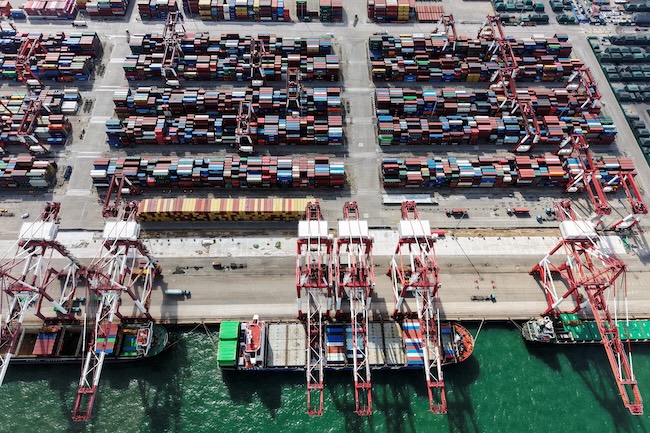
A drone view shows ships and containers at the port in Qingdao, Shandong province, China October 20, 2025. China Daily via REUTERS
The International Monetary Fund on Friday urged Asia to lower non-tariff barriers and integrate regional trade to reduce its vulnerability to U.S. tariffs and global financial shocks.
Trade has been central to Asia's economic growth with China serving as the supply chain hub for goods production across the globe, which makes it vulnerable to the hit from U.S.-China trade tensions and President Donald Trump's tariffs, the IMF said in a regional economic outlook report for Asia.
Trade friction with the U.S. and an investment boom in artificial intelligence have led to rising intra-regional trade in Asia, the report said.
Promoting further regional trade integration, including by removing trade barriers, could help Asian countries diversify export markets, reduce costs and offset some of the headwinds from the tariff shocks, it said.
"If Asia integrates more within the region, that itself provides you a buffer against external shocks," Krishna Srinivasan, director of the IMF's Asia and Pacific Department, told Reuters.
Asia is highly integrated in intermediate goods trade, with about 60% of total exports made within the region, Srinivasan said. By contrast, only 30% of final goods exports by Asian countries are made within the region - a sign of the region's reliance on U.S. and European markets, he added.
The report said Asia can benefit from pursuing broader-based trade agreements, such as one seen in the European Union, as its current focus on bilateral agreements create overlapping rules and inconsistent standards.
Lowering non-tariff barriers, which increased during the COVID-19 pandemic and remain pervasive in Asia, could deliver sizable benefits, it said.
In fact, some countries are voluntarily reducing non-tariff barriers as part of trade negotiations with the U.S., which is a "very positive" trend, Srinivasan said.
With greater regional trade integration, Asia could see gross domestic product rise by as much as 1.4% over the medium term, and the Association of Southeast Asian Nations economies by as much as 4%, Srinivasan said.
"There is a silver lining in that some countries, which had to liberalise anyway, are now liberalising," he said.
The IMF expects Asia's economy to expand 4.5% in 2025, slowing from 4.6% last year but up 0.6 percentage point from its estimate in April, due to strong exports driven in part by front-loading of shipments ahead of higher U.S. tariffs.
It expects growth to slow to 4.1% in 2026 due to the impact of trade tensions, weak demand in China and soft private consumption in emerging economies.
"While trade policy uncertainty has declined somewhat compared to April, it remains high and could weigh on investment and sentiment more than expected," the IMF said in the report.
(Reporting by Leika Kihara; Editing by Lincoln Feast.)
© 2025 by Asian Media Group Inc.
Recent Articles
- Charles Schwab Working with Cboe to Enter Prediction Market
- Mexico's Love Affair with All Things Korean — Until Thursday's Kickoff
- The Making of a Striking Tiger
- Japan's World Cup Prospects Brighter Than Their Single Group Point Might Suggest
- International Stars in the Red Devils' Lineup Suggests a Deep World Cup Run for S. Korea
- Italy's Meloni Says Trump 'Totally Invented' Story That She Begged Him for Photo
- Lebanon Ceasefire Agreed After US-Iran Talks in Switzerland Scrapped
- Qantas Bets on Sleep and Light Science to Sell 20-Hour Flights
- High-Wire Diplomacy Delivered US-Iran Deal but the Tricky Part's to Come
- Pentagon Asks for $80 Billion for Iran War Bills