

Russia Needs Millions of Skilled Migrants Says Top Banker
By Reuters | 24 Oct, 2025
A key Putin ally calls for more immigration to restore growth and end the severe labor shortage caused in large part by the Ukraine invasion.
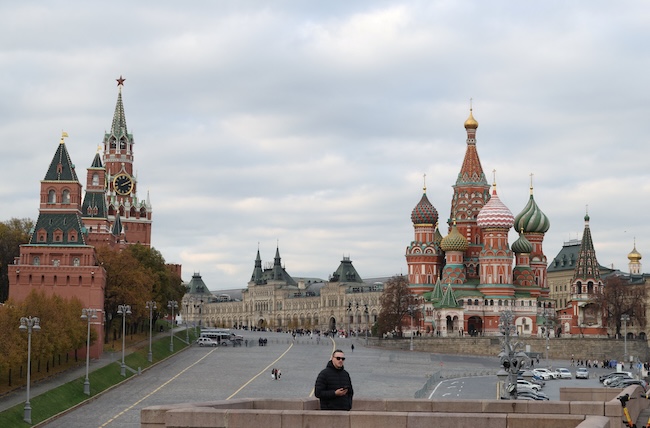
A man uses a mobile phone while standing on a bridge located near the towers of the Kremlin, St. Basil’s Cathedral, and the State Department Store, GUM, in central Moscow, Russia, October 23, 2025. REUTERS/Ramil Sitdikov
Russia will need to attract millions of skilled migrants to achieve an economic growth rate of at least 3.2% and sustain its economy, the country's top banker and longtime ally of President Vladimir Putin said on Thursday.
German Gref, CEO of Russia's largest lender Sberbank, told members of the State Council on Demographic and Family Policy that higher growth could only be achieved by either increasing productivity or expanding the workforce.
"Without economic growth, there will be nothing. We won't be able to solve social problems, or any others. We must grow at a rate no lower than the global average. That means at least 3.2% annually until 2030," Gref said.
The country has faced acute labour shortages across multiple sectors since the start of the war in Ukraine, as hundreds of thousands joined the military. Generous payouts to army volunteers have also triggered a wage growth spiral.
Sberbank expects Russia’s economic growth to plunge to 0.8% in 2025, down from 4.3% last year. The central bank is expected to decide on its key interest rate on Friday, with economists evenly split on the outcome.
Gref argued that with high interest rates and limited investment capital due to Western sanctions making productivity gains difficult, the only viable path forward was to attract skilled labour from abroad.
Migration remains a politically sensitive issue in Russia, and public calls to increase migrant numbers are rare.
Russia has relied on foreign workers, mainly from ex-Soviet republics in Central Asia, in sectors such as construction and municipal services. Migration has been restricted since a deadly attack at a Moscow concert hall in 2024.
"Unfortunately, we are engaging in negative selection. We mostly attract very low-skilled labour, while we ourselves are losing highly qualified specialists,” Gref said. Many professionals fled Russia after the war began.
He urged the government to actively seek qualified professionals from abroad and create incentives for foreign students to remain in Russia after graduation.
"It is a matter of national security and the survival of the country," he said.
(Reporting by Darya Korsunskaya, writing by Gleb Bryanski, Editing by Alex Richardson)
© 2025 by Asian Media Group Inc.
Recent Articles
- Charles Schwab Working with Cboe to Enter Prediction Market
- Mexico's Love Affair with All Things Korean — Until Thursday's Kickoff
- The Making of a Striking Tiger
- Japan's World Cup Prospects Brighter Than Their Single Group Point Might Suggest
- International Stars in the Red Devils' Lineup Suggests a Deep World Cup Run for S. Korea
- Italy's Meloni Says Trump 'Totally Invented' Story That She Begged Him for Photo
- Lebanon Ceasefire Agreed After US-Iran Talks in Switzerland Scrapped
- Qantas Bets on Sleep and Light Science to Sell 20-Hour Flights
- High-Wire Diplomacy Delivered US-Iran Deal but the Tricky Part's to Come
- Pentagon Asks for $80 Billion for Iran War Bills