

When Will Photonics Supersede Silicon?
By Goldsea Staff | 02 Feb, 2026
Photonics' promise as the speed- and energy-efficient alternative to silicon chips is being fulfilled in increments, starting with specialized applications.
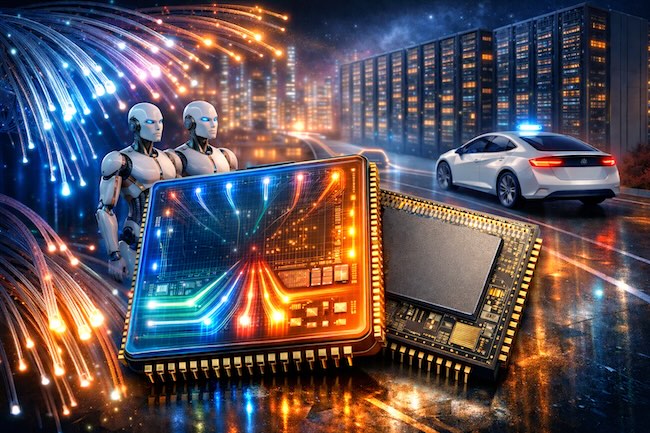
(Image by ChatGPT)
For decades, the semiconductor industry has followed Moore's Law with remarkable consistency, doubling the number of transistors on a chip roughly every two years. But as silicon transistors approach atomic scales and face fundamental physical limits, the computing world is searching for alternatives.
Among the most promising candidates is photonics—technology that uses light instead of electrons to process and transmit information. The question on many technologists' minds isn't whether photonics will play a larger role in computing, but when it will truly compete with or even supersede silicon in mainstream applications.
The appeal of photonics is compelling. Light travels faster than electrical signals, generates less heat, and can carry vastly more data through wavelength division multiplexing, where multiple signals travel simultaneously on different colors of light.
In data centers, where energy consumption and heat management are existential challenges, photonics offers tantalizing solutions. A photonic interconnect can theoretically move data between chips or across a data center with a fraction of the power required by copper wires, while avoiding the signal degradation that plagues high-speed electrical connections.
Despite these advantages, photonics hasn't displaced silicon. Walk into any computer store, and you'll find CPUs and GPUs built entirely on silicon technology, just as you would have twenty years ago. The fiber optic cables carrying internet traffic rely on photonics, true, but the actual computation still happens in silicon.
Understanding this gap between potential and reality reveals both the promise and the challenges facing photonic computing.
Data Movement vs. Computation
Photonics already dominates in certain niches. Telecommunications networks have used optical fiber for long-distance data transmission since the 1970s, and this technology has only grown more sophisticated. More recently, photonics has made inroads into data centers through silicon photonics—integrating optical components with silicon chips to enable faster communication between servers. Companies like Intel, Cisco, and Broadcom have shipped millions of silicon photonic transceivers that convert electrical signals to optical ones and back again.
But these applications leverage photonics for data movement, not computation. The fundamental challenge is that while photons excel at carrying information quickly over long distances, they're far less suitable for the logic operations that define computing.
Electrons can be easily controlled, stored in transistors, and manipulated to perform the complex Boolean logic underlying all software. Photons, by contrast, are difficult to confine and manipulate at small scales. Building the photonic equivalent of a transistor—an optical switch that's compact, energy-efficient, and reliable—remains an ongoing challenge.
Photonics Accelerators for AI
The real action in photonic computing is happening in specialized applications where its strengths align perfectly with specific computational needs. Artificial intelligence and machine learning have emerged as the killer app for photonic processors. Neural network training and inference involve massive amounts of matrix multiplication—operations that move data far more than they transform it. This is precisely where photonics shines.
Several startups are racing to commercialize photonic AI accelerators. Lightmatter, based in Boston, has developed processors that use light to perform matrix operations at dramatically lower power levels than conventional GPUs. Luminous Computing in Silicon Valley is pursuing a similar vision, claiming their photonic chips could offer hundred-fold improvements in energy efficiency for AI workloads.
These aren't vaporware concepts—these companies have demonstrated working prototypes and secured hundreds of millions in venture funding.
Additional Processing Steps
The timeline for mainstream adoption depends largely on solving several technical hurdles. Manufacturing remains a major challenge. Silicon chip fabrication benefits from seventy years of refinement and billions of dollars in infrastructure. The semiconductor industry can reliably produce chips with features measured in nanometers using well-understood processes. Photonic devices, while often built using silicon photonics techniques compatible with existing fabrication facilities, require additional processing steps and face unique challenges in ensuring that optical components meet the precision requirements for reliable light manipulation.
Photonics-Silicon Integration Adds Complexity
Integration represents another significant barrier. A photonic processor doesn't eliminate the need for silicon—it needs conventional electronics for control, memory, and many types of logic operations. Creating efficient hybrid chips that combine photonic and electronic elements requires solving complex engineering problems around heat management, signal conversion, and physical layout. Co-packaged optics, where photonic chips sit alongside silicon processors in the same package, is one approach gaining traction, but it adds cost and complexity.
Software Ecosystem
Then there's the software ecosystem. Decades of development have optimized compilers, libraries, and frameworks for silicon processors. Photonic processors will need their own software stacks, and developers will need to learn new programming models to take advantage of their unique capabilities. This isn't an insurmountable challenge—the industry successfully navigated similar transitions with GPUs—but it will take time and significant investment.
Higher Fabrication Cost
Cost is perhaps the most practical consideration. Silicon chips benefit from enormous economies of scale. Fabrication plants cost billions to build, but they can produce millions of chips once operational. Photonic processors, at least initially, will be more expensive per unit, limiting their adoption to applications where performance or efficiency gains justify the premium. As production scales up, costs should decrease, but reaching price parity with silicon for general-purpose computing may take decades.
Growing Momentum
Despite these challenges, the momentum behind photonics is real and growing. The AI boom has created urgent demand for more efficient computing, and the laws of physics are making traditional silicon scaling increasingly difficult and expensive. Major technology companies are investing heavily in photonic research. Google, Microsoft, and Amazon are all exploring photonic technologies for their data centers. The European Union has funded major photonics research initiatives, recognizing the technology's strategic importance.
Academic research continues to push boundaries. Researchers at MIT, Stanford, and other institutions are developing new materials and architectures for photonic computing. Breakthroughs in nonlinear optics, photonic crystals, and integration techniques appear regularly in journals. Some researchers are even exploring exotic approaches like using photonic chips for quantum computing, where light's quantum properties could enable entirely new computational paradigms.
Hybrid Systems
The most realistic near-term scenario isn't photonics replacing silicon but complementing it. Hybrid systems that use photonics for specific tasks—AI inference, data movement, certain types of signal processing—while relying on silicon for general computation and control seem likely to emerge first. Data centers might deploy photonic AI accelerators for machine learning workloads while continuing to use conventional servers for everything else. This gradual integration allows the technology to mature while delivering immediate benefits in targeted applications.
Long-Term Potential
Looking further ahead, some envisions a future where photonics handles an increasing share of computational tasks. As manufacturing improves and costs decrease, photonic processors might expand from AI acceleration to graphics processing, scientific simulation, and other parallelizable workloads. Eventually, photonics could become the default for any computation involving large-scale data movement and transformation.
But general-purpose computing—the kind that runs operating systems, web browsers, and word processors—will likely remain in silicon's domain for the foreseeable future. The versatility and maturity of electronic processors, combined with the enormous software ecosystem built around them, creates massive inertia. Unless photonics can offer compelling advantages for these applications, not just niche ones, wholesale replacement seems unlikely.
The question of when photonics will supersede silicon may ultimately be the wrong question. A better framing might be: when will photonics become essential to computing? By that measure, we're already there in telecommunications. We're approaching it in data centers. And if current trends continue, we'll reach it in AI and machine learning within the next few years. The age of photonic computing isn't waiting for some future breakthrough—it's arriving incrementally, application by application, as the technology matures and finds its natural niches.
Photonics and silicon together will enable computing capabilities that neither could achieve alone. Light and electrons, working in concert, might carry us beyond the limitations of Moore's Law into a new era of computational power. That future is already taking shape in research labs and data centers around the world as photonics becomes an indispensable part of computing's next chapter.
Recent Articles
- Your Answers to These 7 Questions Will Reveal Whether You're Sane or a Closet Lunatic
- US Oil Companies Profit from Strait of Hormuz Closure Says Russian Oil CEO
- Trump Faces New Republican Resistance in Congress as Midterms Approach
- SpaceX IPO Already Two Times Oversubscribed
- SpaceX Signs Google As AI Compute Client After Landing Anthropic
- $1 Trillion in Stock Market Valuation Erased by AI Chip Selloff
- Anthropic Urges Industry Pause As AI Nears Recursive Self-Development
- Trump's South Lawn UFC Birthday Bash to Mix Politics with Punches
- Trump Policies Targeting 39 Nationalities of Immigrants Invalidated
- One Man Holds Back the World's Progress toward Green Energy Sufficiency and Prosperity