

Yuegang Zhang Boosts Battery Energy-Density
By wchung | 20 Jun, 2026
Yuegang Zhang pioneers the use of graphene to fortify fragile but efficient electrode materials.
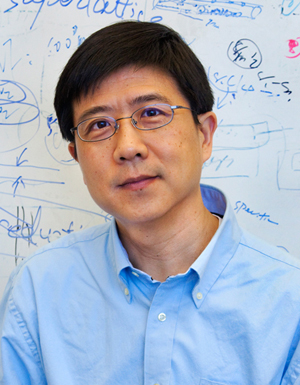
Yuegang Zhang is an investigator focusing on nanoscale structures at the Lawrence Berkeley National Laboratory.
Yuegang Zhang has devised a nano-structure that allows batteries to boost energy density to up to four times that of existing lithium-ion batteries by using a tin-graphene combination as the electrode material.
Tin and silicon are potentially highly efficient battery electrode materials because they take in more lithium during charging and recharging than conventional carbon electrodes. The problem is, both are unstable. Tin, for example, takes up so much lithium during charging that its volume expands two to three times.
“This forms cracks,” says Yuegang Zhang, an investigator at the Lawrence Berkeley National Laboratory, “and the tin leaks into the electrolyte and is lost.”
Zhang solved the problem by sandwiching two layers of tin nanopillars between three sheets of graphene, single-atom-thick sheets of carbon mesh. Graphene offers the unique combination of high conductivity, flexibility and strength that has yet to be matched.
The pillar structure allows the tin to expand and contract during charging without breaking while providing ample space between the pillars for the battery electrolyte material to flow freely for faster charging. The resulting tin-graphene prototype batteries can charge in a speedy 10 minutes and store about 700 milliamp-hours per gram of charge, several times the 150-250 mA-h/g density of conventional lithium-ion batteries.
At this stage the battery’s biggest drawback is the 30-charge-cycle life. To be economically viable the batteries would have to function for hundreds of charge cycles.
“The performance they have is quite reasonable, and this has a pretty clear application in existing batteries,” says Yi Cui, a Stanford University associate professor of materials science who was not involved with Zhang’s work.
Zhang is also at work on batteries that use the nanopillar structure with silicon and other fragile but potentially highly efficient electrode materials.
“People typically assume that a fancy nanoscale structure will cost more, but it may not,” says Zhang. He is hoping the batteries’ efficiency will offset the added manufacturing cost.
Yuegang Zhang received a B.S. and an M.S. in physics from Beijing’s prestigious Tsinghua University. He earned a PhD in materials science & engineering from the University of Tokyo. In 1995 he won the Japan Society for the Promotion of Science (JSPS) Fellowship for Young Scientists. His research areas include nanotubes, nanowires, graphene, nanoscale heterostructures, functionalization and self-assembly, nanoelectronics, non-volatile memory technologies and energy storage.
© 2026 by Asian Media Group Inc.
“People typically assume that a fancy nanoscale structure will cost more, but it may not.”
Recent Articles
- New Bangladesh Premier to Seek Investments, Jobs in China, Malaysia
- Charles Schwab Working with Cboe to Enter Prediction Market
- Mexico's Love Affair with All Things Korean — Until Thursday's Kickoff
- The Making of a Striking Tiger
- Japan's World Cup Prospects Brighter Than Their Single Group Point Might Suggest
- International Stars in the Red Devils' Lineup Suggests a Deep World Cup Run for S. Korea
- Italy's Meloni Says Trump 'Totally Invented' Story That She Begged Him for Photo
- Lebanon Ceasefire Agreed After US-Iran Talks in Switzerland Scrapped
- Qantas Bets on Sleep and Light Science to Sell 20-Hour Flights
- High-Wire Diplomacy Delivered US-Iran Deal but the Tricky Part's to Come