

How Don Can Leave a Very Cool and Smart Legacy After All
By Tom Kagy | 20 Apr, 2026
His apparent dominium over a slavish GOP majority gives Trump the power to legalize every possible recreational drug and free the US from the rising cost of drug deaths and the ruinous law-enforcement industrial complex.
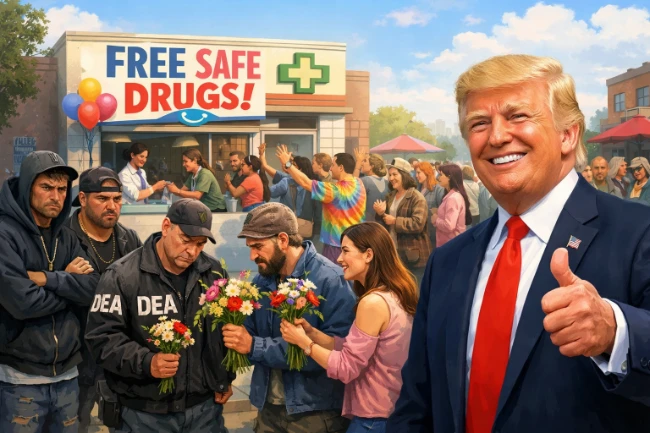
(Image by ChatGPT)
True, the first 15 months of Don's 2nd term has easily been the most disastrous and pointlessly disruptive presidency of all time. What with his failed tariffs, polarizing mass deportations that have caused a spike in labor costs and his childish itch to use pricey whiz-bang war toys that have been beggaring us taxpayers, he has managed to turn the US into a domestic war zone and an international outlaw.
Yet, somehow, he has managed to do one thing that few president achieve: absolute mastery over a compliant and cowardly congress that will back him on even the dumbest and most wasteful initiatives.
And to set the stage, he's shown his ability to be rational about drugs with his order speeding up the use of psychedelics to treat PTSD and other mental health conditions.
So all is not lost. Trump is exactly the right person to do what no one else is likely to be in position to do: cure what has been—and will continue to be—America's great cancer—the law-enforcement industrial complex growing fat on our insane drug policy.
We’ve spent over fifty years, trillions of dollars, and untold human lives trying to punch our way out of a social problem created in large part by our insanely stupid drug policy.
We’ve militarized local police, filled our prisons to the rafters, and watched as the drugs on our streets became more potent, more dangerous, and easier to find than a decent avocado at the grocery store. It’s an approach that has failed by every measure, putting our society at risk of becoming a domestic war zone that threatens the safety of every citizen.
It’s time to legalize, regulate, and treat addiction like the healthcare crisis it actually is.
The current strategy is built on a fundamental misunderstanding of human nature. We’ve treated drug use as a moral failing or a criminal choice, believing that if we just make the punishments scary enough, people will stop. But addiction doesn't care about a judge’s gavel.
When someone is caught in the grip of a substance like fentanyl or meth, they aren’t weighing the "cost-benefit analysis" of a five-year prison sentence. They are trying to stop the physical and psychological agony of withdrawal or trying to numb a life that feels unbearable. Criminalization doesn't cure that pain; it just adds a criminal record to it, making it even harder for that person to ever get a job, find housing, or rejoin society.
The most glaring issue with the status quo is the "Iron Law of Prohibition." When you make something illegal, the market doesn't vanish; it just goes underground and gets more concentrated. Because smugglers want to maximize profit and minimize volume, they push the strongest stuff possible. That’s how we got from opium to heroin, and from heroin to the fentanyl nightmare we’re living through today.
In a legal, regulated market, you know exactly what you’re getting. You don’t have people dropping dead because their weekend party favor was laced with a lethal dose of elephant tranquilizer. By legalizing and regulating opioids and other substances, we pull the rug out from under the cartels and gangs, moving the "pharmacy" from a dark alley to a supervised clinic.
So, what does a sane system look like? It starts with radical empathy and a lot of paperwork. Instead of handcuffs, let’s offer registration to treat long-term addicts as mental health patients. If you're struggling with a chronic substance use disorder, you should be able to register with a state-run health program. Registered patients would have access to safe, pharmaceutical-grade doses in a supervised setting.
Why give them the drugs? Because it stops the "hustle." When an addict doesn't have to spend sixteen hours a day stealing catalytic converters or risking their life in sex work just to avoid getting sick, they suddenly have something they haven’t had in years: time. Time to talk to a counselor. Time to see a doctor about that STD. Time to think about a future that doesn't involve a body bag. You can't rehabilitate a corpse, and you can't treat someone who is constantly running from the cops.
Now let's finally face the root cause of addiciton. People don't generally wake up in a vacuum and decide to ruin their lives with narcotics. Addiction is a disease of despair. It flourishes in places where the factories have closed, where the schools are crumbling, and where the only thing that feels certain is that tomorrow will be just as bleak as today.
We have spent billions on SWAT teams and DEA raids; imagine if we redirected half of that money into free relatively safe, quality-controlled narcotics for registered addicts, job training and placement, housing, and robust social and mental health services. If we address the trauma, the isolation, and the lack of opportunity that leads people to use in the first place, the demand for drugs will naturally shrink.
Critics will say this is "giving up" or "condoning drug use." I’d argue that what we’re doing now—letting 100,000 Americans die of overdoses every year while enriching violent cartels—is the real surrender.
Legalization isn't about saying drugs are "good." It’s about admitting that prohibition is worse. It’s about taking the billions we waste on incarceration and putting it into a public health infrastructure that actually saves lives. It’s about realizing that a person in the throes of addiction is a neighbor, a child, or a parent who needs a doctor, not a cellmate.
We have to stop looking at this through the lens of "tough on crime" and start looking at it through the lens of "smart on reality." When we treat addicts as patients rather than pariahs, we strip away the both the stigma that keeps people in the shadows and the transient glamour that get kids hooked. We replace the violent black market with a regulated system that emphasizes harm reduction and long-term recovery.
We’ve fought the "war" for fifty years and we lost, badly. It’s time to try peace. It’s time to bring our less fortunate fellow citizens in from the cold, give them the medical support they need, and finally address the broken hearts and empty pockets that fuel this epidemic. Let's end the drug war and start the healing process,
And Don is uniquely positioned to do it with a slavishly devoted GOP controlling Congress for the next seven months or so. Get on it, Don, before it's too late!
© 2026 by Asian Media Group Inc.
Recent Articles
- Newsom Says Trump Sending Agents to Homes of Friends, Family
- North Korea Touts Industrial ‘Miracles’ as Output Exceeds Targets
- Global EV Registrations Rose 3% in May
- China's Industrial Output Grew Faster in May but Retail Sales and Investment Slowed
- Asia Markets Temperate in Assessing Likely Delayed Impact of Iran Deal
- Japan's Auto Shops Unlikely to See Quick Relief from US-Iran Deal
- Hermanos Coreanos, Clarkson Crowned, Jung Hoo Lee Sets Record
- California Congressman Dave Min Presses Trump on “Pay-To-Play” Pardons
- China's Heavy Truck Electrification to Hit Diesel Demand
- Trump Push into Highly Dangerous Plutonium Unlikely to Fix US Nuclear Fuel Crunch