

How Historically Plausible Is Bridgerton's Rich Ethnic Mix?
By Goldsea Staff | 11 Mar, 2026
The race-blind casting of actors of African, Indian and East Asian descent in the popular Netflix series finds some historical support.
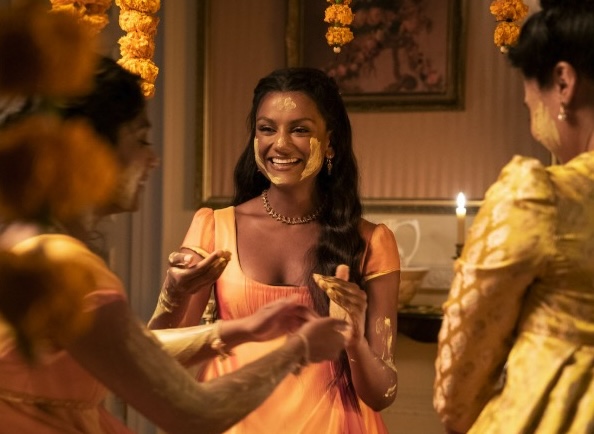
Kate Sharma is played by Simone Ashley. (Netflix Image)
Those of us able to take our eyes off the spectacular gilded halls and sumptuous costumes regaling us on Bridgerton may have noticed that its 1812 - 1815 London society has far more multi-racial cast than supposed. Lords and ladies of African, Indian, Chinese and Korean descent cavort and entangle romantically with the homogenous White population one generally assumes for the era's English society.
This is by no means to say we don't fully support showrunner Shonda Rimes's colorblind casting philosophy. After all, a bit of retrospective social engineering to appeal to today's global audience makes sense for a series that trades in a rich blend of fantasy and social comedy.
But those of us who can't shut off our brains long enough to simply enjoy the multi-cultural melange can't be blamed for pursuing some historical inquiry to see the degree of verisimilitude to early 19th century London society.

Queen Charlotte is played by Golda Rosheuvel. (Netflix Photo)
The Queen Charlotte Argument
The most direct in-universe justification the show itself uses is that Queen Charlotte (who reigned as consort 1761–1818) was of African descent — a real historical claim, not a fictional invention.
Several historians, most notably Mario de Valdes y Cocom, have argued that Charlotte of Mecklenburg-Strelitz descended from a Black branch of the Portuguese royal family, itself descending from Margarita de Castro e Sousa, a 13th-century noblewoman of documented African lineage.

Sophie Baek is played by Yerin Ha. (Netflix Photo)
The evidence is contested but not trivial — contemporary portraits by Allan Ramsay were noted by observers to show distinctly African features, and her own family acknowledged the ancestry. If one accepts even partial validity to this claim, it opens the logical door the show walks through: a monarch of colour would logically attract, elevate, and patronise courtiers and nobles who shared that background.
Historical Precedents for Black Aristocracy
The many Black characters we see in virtually every scene of Bridgerton are perhaps the most abundantly supported by the historical record, albeit at a substantially lower percentage than in the show. There were real individuals of African descent integrated into British elite society during this period:
- Julius Soubise (c.1754–1798) was freed from slavery, taken under the wing of the Duchess of Queensberry, and became a celebrated figure in fashionable London society — fencing, riding, and mixing with the aristocracy. He was a social sensation rather than a peer, but illustrates the porousness of elite circles.
- Dido Elizabeth Belle (1761–1804) — made famous by the 2013 film — was the illegitimate mixed-race daughter of a Royal Navy admiral, raised at Kenwood House by the Lord Chief Justice, Earl Mansfield. She occupied a genuinely ambiguous but elevated social position.
- Charles Ignatius Sancho (1729–1780) was a celebrated composer, writer and the first Black Briton known to vote in a parliamentary election, corresponding with Laurence Sterne and moving in cultivated circles.
These figures were exceptional and often occupied awkward social positions — celebrated but not quite fully equal. But they demonstrate that integration at elite levels was *possible* and documented.
South Asian Presence
Kate Sharma and her family play a central role in Season 2, with Kate continuing to make sporadic appearances in subsequent seasons as Anthony Bridgerton's wife.
The Indian presence is arguably the most historically grounded of all. By 1800–1815, the East India Company had been transforming British society for generations:
- Nabobs — Englishmen who had made fortunes in India — were a recognised and satirised social class, often returning with Indian wives or mixed-race children they sought to integrate into English society.
- There were a small number of Indian-born men who came to Britain, received educations, and entered professional and even political life. Sake Dean Mahomed (1759–1851) is the most famous — he opened Britain's first curry house and became shampooing surgeon to George IV.
- Wealthy Indian merchants and princes visited or settled in Britain, sometimes moving in aristocratic circles. The Mughal world's extreme wealth gave certain Indian visitors social leverage in ways that other ethnic groups did not have.
- Mixed Anglo-Indian families from the Company's orbit were quietly integrated into English gentry life, particularly in counties like Kent and Somerset with strong EIC connections.
Chinese Presence
We see a startling abundance of Chinese faces, albeit mostly female, throughout the Bridgerton series. This is the thinnest historical thread. There was a small but real Chinese presence in London — primarily around the docks of Limehouse — but integration into the aristocracy is essentially undocumented. However:
- Chinoiserie was at the absolute height of English aristocratic fashion in precisely this period. The Prince Regent's Brighton Pavilion (under construction 1787–1823) is perhaps the most famous example. This created genuine cultural fascination and some social contact with Chinese visitors.
- A small number of Chinese students and diplomats were received in elite settings.
The show's Chinese lords and ladies have minimal historical anchors, but the cultural obsession with China among the Regency elite gives it a loose contextual plausibility.
Korean Presence
Sophie Baek plays the central role in Season 4 as the daughter of a Korean lord with the surname Gun titled Lord Penwood. The Bridgerton era coincides almost exactly with the late Joseon Dynasty (1392–1897), which was at this point operating under an extremely strict policy of isolation — so severe that Korea had earned the Western nickname "the Hermit Kingdom." This was not merely cultural preference but enforced state policy:
— Foreign contact was tightly restricted and controlled by the government
The only sanctioned external relationships were with China (as a tributary state) and very limited contact with Japan through a single designated trading post at Dongnae.
— Western ships that approached Korean shores were routinely turned away, sometimes forcibly
— Koreans who left the peninsula without authorisation faced serious legal consequences upon return
This makes the presence of Korean nationals in London during this period almost inconceivable through normal channels.
The Broader Structural Point
It's worth noting that the British aristocracy had always been more ethnically porous than its self-mythology suggested. Wealth, patronage, and royal favour could open doors that formal rules might seem to close. The period 1780–1820 specifically — with massive flows of money from the Caribbean, India, and the slave trade — created new fortunes and new social mobility. A world in which that wealth occasionally translated into titles and social standing for people of colour isn't historically absurd; it's simply a more generous version of what was actually beginning to happen.
The show essentially asks: what if the accidents of history had broken slightly differently? The answer is that the historical raw material for exactly this world actually existed in many cases.
© 2026 by Asian Media Group Inc.
Recent Articles
- US Holds off Blacklisting DeepSeek, Over 100 Firms Deemed Security Risks
- Vietnam Maintains 2026 GDP Target Despite Trade Deficit, Inflation Pressure
- China Makes New Push to Take Yuan Global
- Iran Deal Includes $300 Billion Investment Fund, With Over Half Already Committed
- US Senate Narrowly Blocks New Bid to Rein in Trump War Powers
- BYD Ramps up Battery Production in Brazil
- Intel Begins Chip Production with New Fabrication Process
- 'Wingman' Drone Key Piece of EU's Defense Self-Reliance
- Keiko Fujimori Edges Ahead in Brutal Contested Vote Count
- Chip Queen He Tingbo Subverts Moore's Law to Overturn the Global Semiconductor Hierarchy