

Musk Wanted $80 Billion to Colonize Mars Testifies OpenAI President
By Reuters | 05 May, 2026
OpenAI co-founder Musk wanted to turn the startup into a for-profit company but wanted full control to help raise $80 billion to colonize Mars, testified company president Greg Brockman.
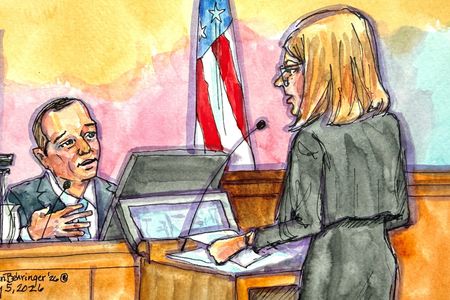
OpenAI President Greg Brockman is questioned by OpenAI attorney Sarah Eddy, during Musk's lawsuit trial over OpenAI's for-profit conversion at a federal courthouse in Oakland, California, U.S., May 5, 2026 in a courtroom sketch. REUTERS/Vicki Behringer.
The president of OpenAI testified on Tuesday that Elon Musk supported transforming the artificial intelligence startup into a for-profit company, but wanted full control in part to help him raise $80 billion to colonize Mars.
Under questioning from an OpenAI lawyer, Greg Brockman said that in 2017 Musk wanted OpenAI to change its corporate structure because it was too hard for a nonprofit to raise the amount of money OpenAI required to build advanced AI models.
Brockman said the Tesla and SpaceX founder made clear that he wanted to become OpenAI's leader if that happened.
Sam Altman, now OpenAI's chief executive, was the only other candidate, Brockman said.
Brockman described a particularly intense meeting in which Musk said he deserved a majority stake in OpenAI because of his business experience. Musk said he intended to use that stake to build a self-sustaining city on Mars, according to Brockman.
"He said he needed $80 billion to create a city" on Mars, Brockman said. "In the end, he needed full control." Brockman added that Musk said he would decide when to relinquish full control of the company.
Musk, who co-founded OpenAI, is suing the company on grounds that it improperly became a for-profit company, abandoned charitable goals and should turn back into a nonprofit.
The trial, in its second week in a California courtroom, could determine the future of OpenAI, which sparked a widespread craze over generative artificial intelligence after launching its ChatGPT chatbot in late 2022.
OpenAI plans to spend $50 billion on computing resources in 2026, Brockman said in court.
MEETING DETERIORATES
Brockman said the meeting with Musk in August 2017 started well. He said Musk had recently given Teslas to some OpenAI employees in gratitude for their work, and former OpenAI chief scientist Ilya Sutskever painted a portrait of a Tesla to give to Musk as a token of thanks.
But according to Brockman, Musk grew angry when discussing a potential equity structure for OpenAI that he didn't like, saying "I decline."
Brockman said Musk stood up and walked over so fast he was concerned Musk would hit him, but instead Musk picked up Sutskever's painting and stormed out, saying he would withhold new funding until matters were sorted.
Musk alleges that he was conned by OpenAI chief Altman into giving $38 million to the nonprofit, only to see it abandon its charitable goals and become a for-profit company to enrich themselves.
He is seeking $150 billion in damages to be paid to the nonprofit and for Altman and Brockman to be removed from their leadership roles.
OpenAI has said Musk was embittered because he left its board before the company's successes, and now wants control. It also said Musk sued to bolster his own AI company xAI, now part of SpaceX.
SPACEX GIVES MUSK INCENTIVE TO GO TO MARS
On Monday, Brockman testified that his stake in OpenAI is worth almost $30 billion. He also said he holds stakes in two startups backed by Altman, and a 1% stake in Altman's family fund.
Evidence in the case includes a 2017 diary entry where Brockman wrote "Financially, what will take me to $1B?”
In March 2019, OpenAI restructured as a for-profit unit governed by the nonprofit, allowing it to accept money from outside investors.
OpenAI has since raised more than $100 billion to hire researchers, buy computing power and expand ahead of a potential $1 trillion initial public offering this year.
SpaceX may also go public this year, in an IPO that could be larger than OpenAI's. According to a registration statement, SpaceX's board in January approved awarding Musk 200 million of super-voting restricted shares if its market value reaches $7.5 trillion and it creates a permanent colony on Mars with at least 1 million people.
(Reporting by Deepa Seetharaman in Oakland, California and Jonathan Stempel in New York; Editing by Sanjeev Miglani)
© 2026 by Asian Media Group Inc.
Recent Articles
- Newsom Says Trump Sending Agents to Homes of Friends, Family
- North Korea Touts Industrial ‘Miracles’ as Output Exceeds Targets
- Global EV Registrations Rose 3% in May
- China's Industrial Output Grew Faster in May but Retail Sales and Investment Slowed
- Asia Markets Temperate in Assessing Likely Delayed Impact of Iran Deal
- Japan's Auto Shops Unlikely to See Quick Relief from US-Iran Deal
- Hermanos Coreanos, Clarkson Crowned, Jung Hoo Lee Sets Record
- California Congressman Dave Min Presses Trump on “Pay-To-Play” Pardons
- China's Heavy Truck Electrification to Hit Diesel Demand
- Trump Push into Highly Dangerous Plutonium Unlikely to Fix US Nuclear Fuel Crunch