

Is Gas Station Sushi the Next 7-Eleven Egg Salad Sando?
By Romen Basu Borsellino | 13 Jan, 2026
Is America's take on cheap sushi founded on legitimate health concerns or mindless snobbery?
My girlfriend and I went so hard at the Indian lunch buffet on New Year's Day that the next several hours were spent napping on the couch. It was not necessarily a productive start to the New Year.
When dinner rolled around, we were both craving something light and healthy-ish. She proposed sushi, a favorite of hers.

US 7-Elevens recently began carrying the popular egg salad sandwiches from their Japansese locations
Still groggy, full, and frankly hungover from the previous night, I proposed the quickest and easiest way of getting sushi I could think of: The sushi bar at Ralph’s grocery store just two blocks away.
At $8.50 each for a 7oz spicy tuna and spicy salmon roll, both of which were drizzled in a spicy mayo sauce, my girlfriend and I were both content with our New Year’s dinner consumed in front of the TV.
I have been an advocate for Ralph’s sushi since I moved to LA. When a former roommate had moved here from Philly years before, I told him that he had to check out their Friday $5 sushi special.
He politely declined: “I don’t do sushi from a grocery store.”

President Obama and Anthony Bourdain enjoyed a no-frills meal in Hanoi, Vietnam
I don’t think he’s alone. While I’m perfectly happy saving some time and money if the product is at least passable, I appreciate that many are unwilling to consume sushi outside of, say, a nice Japanese restaurant.
It’s gotten me wondering: Is it about the quality? The health concerns? Simply the social stigma?
“Gas Station Sushi”

Saturday Night Live's Cecily Strong plays a sushi chef in the musical sketch 'Airport Sushi'
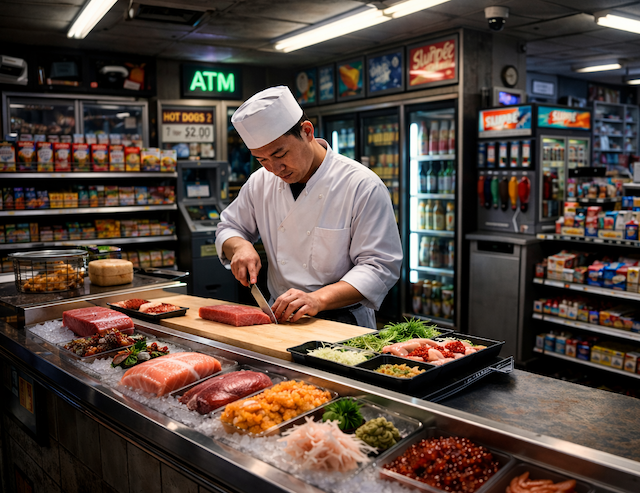
While Ralph’s is, of course, a grocery store, it might still fall under the umbrella of the more ubiquitous term “gas station sushi,” generally used to refer to any sushi that comes from somewhere outside of a nice sit-down restaurant.
In 2020 Saturday Night Live aired a sketch titled “Airport Sushi.”
“I will grab a sushi too” Pete Davidson tells airport convenient store clerk John Mulaney before ominous organ music from The Phantom of the Opera begins playing. What comes next is a full-blown musical number about the disgustingness of the dish and ensuing gastrointestinal distress of anyone who consumes it.
The sketch got big laughs from the audience, in part, because it's a recognizable trope. People are familiar with the stigma surrounding gas station — or in this case airport — sushi.
But somehow other foods don't seem to draw the same scrutiny.
In my home town of Des Moines, many regard the pizza from Casey’s General store — a gas station — as the best in the city.
In Kansas City, “Oklahoma Joe’s,” which has operated out of a gas station since the 1990s, consistently tops lists of best barbecue in the city.
So what makes gas station pizza and barbecue acceptable but not sushi?
For one, health concerns.
Health Risks
Obviously raw fish, if handled incorrectly, has the capacity to make one very ill.
If sushi is not kept at sufficiently cold temperature, it can expose consumers to bacteria like salmonella, listeria, or E.Coli, all of which are typically accompanied by known food poisoning symptoms that I don't need to elaborate.
Even worse is the risk of parasites. A key part of any sushi preparation is freezing the fish so as to kill any potential parasites like roundworm or tapeworm that might be lurking inside. But those who skip this step are putting their diners at risk. And it's not hard to imagine that a place that doesn’t specialize in sushi is less likely to follow the proper protocol.
There’s also a matter of physically handling the fish. Preparing it without properly cleaning one’s hands or doing so in a sanitary environment risks contaminating it with norovirus.
All of this is to say the the health risks of consuming sushi from a questionable source are substantial.
But we shouldn’t confuse actual risks with social stigma surrounding “gas station sushi.”
I believe one of the driving forces behind an aversion to “gas station sushi” is simply gate-keeping.
Gate-keeping
In the US, sushi is considered a delicacy. I imagine businessmen in suits holding nigiri between chopsticks during a power lunch on Wall St.
Such diners may be of the mindset that sushi belongs to them, a prerogative reserved for the wealthy.
So I started thinking about someone who detested gate-keeping and spent much of his career attempting to break-down culinary barriers: Anthony Bourdain.
The late food aficionado routinely ridiculed fine-dining and expensive tasting menus. His famed dining moment with President Obama was not to a high-end Michelin Star restaurant. Instead, they sat on low plastic stools and slurped down $6 street noodles at a hole in the wall in Hanoi, Vietnam.
“Your body is not a temple,” I remember Bourdain once proclaiming. “It’s an amusement park. Enjoy the ride.”
I was sure that he would abhor the idea that some types of sushi are worthy of scorn. So I did some digging.
Boy was I wrong.
"I can't imagine a better example of Things To Be Wary Of in the food department than bargain sushi,” Bourdain wrote in the early 1990s.
Would the legendary Anthony Bourdain have scoffed at my New Year’s Day meal?
I’m still holding out hope that he would have allowed it. For one, it was later in life that Bourdain seemed to embrace the idea that food should be as accessible as possible. His thinking may have evolved.
But it’s also likely that the quality of sushi and the ability to serve it anywhere has evolved. In fact, in a 2016 interview Bourdain stated that "Everybody eats sushi now…They can't get away with serving us the crap they used to. We know what fish should look like, smell like, and how it should be cooked optimally."
Perhaps low-end sushi has outgrown the skepticism that is once deserved.
Outside the US
Just last month, I proposed that my girlfriend and I grab egg salad sandwiches from 7-Eleven for lunch.
She naturally laughed… until realizing I was serious. I was well aware of the outlandishness of my proposition: while not quite raw fish, the eggs and mayo that compose such a sandwich could similarly lead to illness if not handled properly.
My desire for the dish had come from hearing an NPR story just days before. I had learned that the egg salad sandwiches served in 7-Elevens in Japan are considered gourmet, and had recently been going viral on TikTok.
To meet the demand, 7-Eleven began replicating the dish in all US stores. These special Japanese egg salad sandwiches were made milk break and a gourmet type of kewpie mayonnaise.
As it turns out this is not the only instance of Japanese 7-Elevens serving popular cuisine. They are also known for their sushi.
One could accurately point out that comparing US 7-Elevens to Japan’s is like comparing Sizzler to the Palm.
But the fact that sushi is so readily accessible in Japan speaks to how it’s perceived outside the US. A co-worker recently returned from Australia and reported the availability of sushi on roadside stands.
Australia is known to have uniquely large handheld rolls that are easily accessible all over the country. It’s even considered a street food.
If they’ve managed to figure it out without consumers dropping dead from food poison, there’s hope for the US.
For now, it seems like there's much work to be done fighting the stigma of low-end sushi. And I”m certainly doing my part.
In the US, sushi is considered a delicacy. I imagine businessmen in suits holding nigiri between chopsticks during a power lunch on Wall St. Such diners may be of the mindset that sushi belongs to them; it is reserved for the wealthy.
Asian American Success Stories
- The 130 Most Inspiring Asian Americans of All Time
- 12 Most Brilliant Asian Americans
- Greatest Asian American War Heroes
- Asian American Digital Pioneers
- New Asian American Imagemakers
- Asian American Innovators
- The 20 Most Inspiring Asian Sports Stars
- 5 Most Daring Asian Americans
- Surprising Superstars
- TV’s Hottest Asians
- 100 Greatest Asian American Entrepreneurs
- Asian American Wonder Women
- Greatest Asian American Rags-to-Riches Stories
- Notable Asian American Professionals