

Asian Men-White Women: Still the Great American Taboo?
By J. J. Ghosh | 08 Feb, 2026
The sexual and economic jealousy that led to deadly violence against Filipino American men for dancing with White women in Watsonville may still linger in the American media's aversion to depicting the reality of Asian men-White women couples.
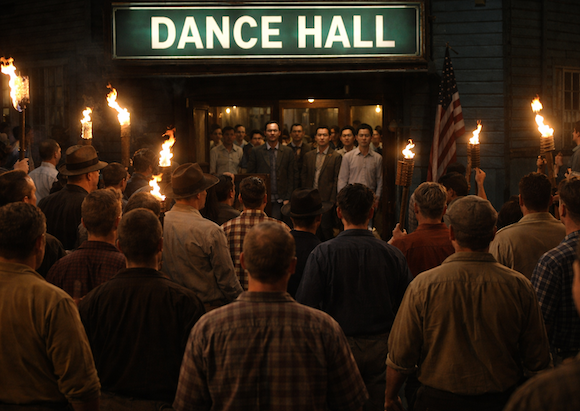
On January 19, 1930, mobs of up to 500 white men descended upon a community of Filipino farmworkers in the Northern California town of Watsonville. For the next five days, Filipinos were robbed, beaten, and even shot. Their property was ransacked.
It was retaliation for the grave sin that a group of Filipino men had committed just days earlier: Dancing with White women.

Local coverage of the tragic Watsonville Riots of 1930
The story of the 1930s Watsonville riots is in one regard a snapshot of a particularly troubled time in our nation’s history. But in another sense, it feels like an incident that could very well have been ripped from today’s headlines.
Relationships between Asian men and White women in the US have by and large failed to achieve normalization in the 96 years since these events, though present day public sentiment is certainly more subtle than the rabid hostility of the 1930s.
But nobody who fully understands the history of Asian Americans in this country, whether Filipino immigrant or first generation, can be stunned by a current lack of social acceptance.

1932's Madame Butterfly depicts romance between an Asian woman and an American GI
Filipino Americans
The Philippines did not gain independence until 1934, which meant that up until then Filipinos were US nationals, free to travel here uninhibited by the 1917 and 1924 Immigration Acts that put quotas on how many Asians could come to the US.
The jobs available to them were anything but glamorous. The Pacific Coast was in desperate need of farm labor, which meant backbreaking work in grueling climate conditions, primarily in California’s arid Pajero Valley.

A snapshot of Filipino Farmworkers in the Pajaro Valley
The primary demographic suited to endure such conditions — at least in the eyes of those hiring — was young men. Therefore, there was a massive gender imbalance in the Filipino American population.
Of the roughly 30,000 Filipino American workers in California, just 1 in 14 were women, which of course set the stage for what would come next.
Suffice it to say that 13 out of 14 Filipino men looking for romantic female companionship would have few choices beyond dating non-Filipinos. Predictably, these young Filipino bachelors turned to the most widely available option: local women who happened to be White.
It’s not hard to see what drew the women in: Aside from the toned physiques that came from non-stop manual labor, these men brought their own culture with them, which included fashionable attire and a love of night life from pool and dance halls to street fairs.
Yet, White locals —including the police— simply couldn't wrap their heads around the idea that women would be interested in Filipino men of their own accord. Instead, they insisted that Filipinos were paying the women to dance with them at dance halls.
White locals insisted that the Filipino men’s behavior was predatory. While they may have masked their hostility with claims of safety concerns for the women, it certainly seemed like these locals were simply jealous of their new competition.
And it wasn’t just about the women. They also cited variations of the standard “They took our jobs” refrain that are commonly directed at immigrants today.
A local judge in Parejo township once stated:
“The worst part of [the Filipino man] being here is his mixing with young white girls from 13 to 17. He gives them silk underwear and makes them pregnant and crowds whites out of jobs in the bargain.”
That same judge also pushed for a resolution declaring Filipinos to be “unwelcome inhabitants.”
It didn’t take long for this hostility to veer toward violence, especially once the White locals began forming vigilante groups to follow and harass Filipino men, especially while they were out with White women.
But in January 1930, tensions escalated beyond a point of no return.
The Incident
While the harassment that these Filipino immigrants began experiencing was commonplace, one particular moment is often regarded as the inciting incidents of the riots.
Watsonville’s Filipinos would frequent the town’s Palm Beach Dance Hall, where they regularly rented a space to hold dances. The property was owned by American brothers Charles and Edward Lock-Paddon.

1967's "Guess Who's Coming to Dinner" helped normalize the idea of a Black man and a White woman dating
On one particular night, a crowd of hundreds of White locals gathered outside as the Filipinos danced inside with White women.
News reports at the time claimed that local police attempted to quell tensions, but years later, the owner’s son would report that that was false. Rather, he claimed, the police were too afraid of the White mob to intervene and instead watched from afar as the two owners and FIlipino dance hall patrons were left to fend for themselves.
While violence erupted, nobody was killed that night, fortunately. But the riots would persist for days, hitting an apex on January 22 when, late into the night, a white mob raided a nearby farm labor camp where many Filipinos lived and worked.
They dragged Filipino men from their beds, beating them close to death, and fired bullets indiscriminately into the housing quarters.
22 year-old Filipino American Fermin Tobero was shot and killed while he slept.
The Aftermath
The death of Tobero effectively ended the riots, but tensions were far from quelled.
In the wake of all that had ensued, the California state assembly convened shortly after to pass legislation ensuring that this would never happen again.
And I don’t mean the violence against Filipino farmworkers. Rather, the state government made it illegal for Filipinos to have relationships with White women.
On April 5, 1933 California Governor James Rolph signed an amendment to the state’s civil code which extended a state-ban on interracial marriage to “members of the Malay race.”
And by 1934, the federal Tydings-McDuffie Act set its sights on Filipino immigrants altogether, restricting the annual immigration allowance to just 50 a year.

The 1959 crime drama Crimson Kimono was one of the earliest instances of depiction of an AM-WF romance.
Beyond Watsonville
While the Watsonville riots are a good encapsulation of the way Asian American men have been treated for daring to romance White women, it is sadly far from the only example.
As NPR reported, at the dawn of the 20th century, “There was the pervasive idea that Chinese men were lecherous threats to white women. Chinese restaurants were considered "dens of vice” where white women were at risk of moral corruption by way of sex, opium and alcohol.”
The 1913 convention of the American Federation of Labor even featured a debate over making it illegal for White women to work at or patronize Chinese restaurants.
In 1909, Japanese American Gunjiro Aoki married his White girlfriend Helen Gladys Emery in Seattle only after the two were driven out of San Francisco and Oregon by lynch mobs. Emery was eventually forced to give up her American citizenship.
The Hays Code
In 1934, as concerns over Asian men dating women appeared to be at an all-time high, another set of discriminatory policies would take effect in Southern California.
Hollywood formally adopted the Motion Picture Production Code, more commonly known as The Hays Code after the organization's President at the time, former Republican politician William H. Hays.
The Hays Code, which lasted for the next 34 years, was a set of conservative standards that the TV and film industry would adhere to, including a ban on nudity, profanity, sexual content and miscegenation aka race mixing.
The very fears that directly led to violence in Watsonville —that Asian men were stealing White women — were now influencing the media landscape, likely to further perpetuate the idea that interracial relationships were unnatural.
The Hays code ended in 1968, one year after the Supreme Court’s 1967 ruling in Loving v Virginia deemed that marrying outside of one’s own race is a constitutionally protected right and thus legalized mixed race marriage.
The fact that the Hays Code continued for even a year after the ruling should be a reminder, however, that law and public sentiment are two completely different matters.
Today it is of course legal to marry someone of any race. But whether American society accepts Asian male-White female couplings today is another matter.
Representation Today
Modern day social bias toward relationships between Whites and Asians comprise two separate questions:
How comfortable are Americans with a White man dating an Asian woman?
And how comfortable are Americans with an Asian man dating a White woman?
A good proxy for societal attitudes on the topic—and perhaps the only one available—for middle-American sentiment on the issue can be inferred from media depictions which tend to cater to middle-American biases.
Today the portrayal of romance between a White man and an Asian woman has more or less been normalized.
Modern shows like How I Met Your Mother, Gray’s Anatomy, and The Morning Show casually depict white men in relationships with Asian women. In cinema, we’ve seen Michelle Yeoh play a Bond girl opposite Pierce Brosnan in Tomorrow Never Dies. In fact, modern media depictions of WM-AF relationships are far too commonplace to bear listing.
Even back in the pre-Hays era that still pretty much stuck to the Code, Madame Butterly told the story of a romance between a White military lieutenant and a Japanese Geisha.
Yes, there have been examples of on-screen Asian male-White female ("AM-WF") romantic pairings on screen, but they tend to be limited to productions featuring a few prominent Asian males.
The renowned actor James Shigeta played opposite Victoria Shaw in the 1959 crime drama The Crimson Kimono which, for its time, dealt surprisingly frankly with the bias against AM-WF romance. The depiction was so rare that the movie poster actually declared, "Yes, this is a beautiful American girl in the arms of a Japanese boy!"
Shigeta also starred in the 1961 biographical drama Bridge to the Sun in which he plays a Japanese diplomat married to a White American (Caroll Baker) during World War II.
John Cho was paired with a White woman in both the short-lived sitcom Selfie and the indie-film Columbus.
Aziz Ansari dates White women in the TV series Parks and Rec and Master of None. Kumail Nanjiani does so in Silicon Valley and the film The Big Sick.
This is of course progress. But it also allows the viewer to think “Aziz Ansari is different” or “John Cho isn’t your typical Asian.”
In other words, the Asian male-White female pairing hasn't yet achieved normalization.
A Triple Threat
Of course historically these issues of societal bias against interracial relationships haven't been unique to the AAPI community.
For every Watsonville that Asian Americans have had to endure, Blacks in America have been forced to live out countless Emmett Till scenarios. Till, a 14 year-old African American, was lynched following accusations that he flirted with a White woman in the Jim Crow South.
But today Black men with White Women is commonplace, but a dearth of AM-WF pairings are difficult to find despite the fact that the past decade has seen real-life percentage of AM-WF marriages reach levels similar to BM-WF marriages.
Data from the past decade in Sciencedirect and Wikipedia show about 8–15% of Black men have married White wives in recent years, with multiple sources converging near the low‑teens for some datasets. For Asian men the percentage who marry White women is about 10–12%, depending on study and year.
Since the 1967 comedy Guess Who’s Coming to Dinner, which addressed the taboo head on, Americans have seen an abundance of media depictions of BM-WF relationships.
Jews are another minority group that has been historically subject to racial hostility in this country, yet are accepted in media portrayals in relationships with White women.
But the persistence of a near-total eclipse of Asian men in media portrayals of interracial pairings which, in reality, are no longer oddities, suggests an unusual degree of bias against AM-WF pairings, even as AF-WM pairings having become practically de rigueur in most TV series and movies. Is this attributable to a modern holdover of the sexual jealousy or hostility that ignited the Watsonville violence?
This anomaly may entail many factors. Some are, in a sense, innocent, like the desire to exploit the sex appeal of "exotic" Asian women from the male perspective since Hollywood (as a proxy for the entertainment industry) remains heavily male-dominant to this day. In other words, the attitude may be, "If we're going to put an Asian in the picture, let's make it a female."
But darker psychological forces may be at work. Asian American commentators have posited three major factors that may militate toward a desire to avoid AM-WF pairings in depicting American society.
One is the Asian economic threat. Just as the Watsonville rioters saw an economic threat of jobs lost to immigrant Filipino laborers, as well as the sexual threat of losing white women, present-day Americans appear to see Asians and Asia as the primary economic threat. For one, the US has been ceding industrial segments to China, Japan and S. Korea. And plenty of Americans don’t care to distinguish between Asians and Asian Americans, most of whom are actually working hard to keep the US economy competitive. And of course seeing the disproportionate prosperity and economic status achieved by Asian Americans, in and of itself, is likely to add to the perception of the Asian male threat.
Another significant psycho-social factor is the fact that the US has been directly pitted against Asian nations in war after war over the past 80 years. Japan was the enemy blamed for setting off World War II. North Korea and China fought the US to a bitter stalemate in the Korean War of the early 1950s. The war to contain communist Vietnamese in the late 60s through 1975 ended disastrously for the US and its South Vietnamese ally.
These wars may have conditioned American society as a whole to reflexively see Asians as the enemy. And you hate to see your enemy making love to your sister.
The third and biggest subliminal threat posed by Asian men may be the fact that globally 4.5 billion Asians outnumber 4:1 the global population of 1.1 billion Whites. AWM-WF couplings may feel to many Whites as seeing the blood of the Mongol horde corrupting America.
So, yes, in today's America Asian men cope with psycho-social barriers not faced by any other minority race of men. It's an awkward topic, but an open consciousness of these factors may be an important first step in erasing their impact on America's perception of Asian American men.
We can only hope that with or without Hollywood's help public sentiment will continue trending in the direction of freedom to love whom we please.
© 2026 by Asian Media Group Inc.
There seem to be three major tentpoles, however, that all contribute to both a fear and hatred of Asian men that manifests in the form of sexual jealousy that feels unique to us
Recent Articles
- Google Limits Meta’s Use of Its Gemini AI Models
- Key Volkswagen Shareholder Pitches Producing China Models in Germany
- S. Korea's Early World Cup Exit Triggers 'Utterly Baffled' Tirade by President
- Anthropic Allowed to Release Mythos AI Model to 'Tusted' US Organizations
- Apple Seeks Approval to Buy from Blacklisted Chinese Company to Ease Memory Crunch
- China's Industrial Profits Stay Resilient on Factories, Exports
- Meet the Teen Who Undertook a 7-Continent Solo Flight Against Cancer
- Getting Fit Pt. 2 - Raising Our Floor
- South Korea Survives World Cup Scare, Advances to Round of 32
- Why Asian-White Marriages Suffer Multiples the Disruption Rates of Asian-Asian Marriages