

Highs and Lows of Asian Multi-Generational Living
By Romen Basu Borsellino | 12 Feb, 2026
Something's lost and something's gained when Asian American families bring multiple generations together under one roof.
A buddy of mine got divorced last year and moved back in with his parents.
“How long until they kick your ass out?” I quipped.
“Are you kidding?” he replied “My parents would love nothing more than for me to live with them the rest of their lives.”

Pew Research's data on multi-generational households
I’ve never met his parents, but given that his family is South Asian like mine, I had zero doubt that he meant it.
There are a number of quirks that any Asian American can relate to. The list includes tiger moms, shoes off in the household, and yes, multiple generations of the same family living together under one roof.
The conversation with my friend was at times crude and facetious — I demanded to know how he managed to have sex while living in a room next to his parents’ — but it also got me seriously wondering what it is about our culture that prioritizes familiar living arrangements in a way that, say, White families, do not.
The Facts
I’ll start by noting that as with many things immigrant-related, experiences that I think are unique to my family are actually pretty common for non-AAPI immigrants as well.
For example, as an Indian-Italian, it didn’t take long to realize that talking with one's hands could just as easily describe either side of my family. And when my relatives do choose to express themselves verbally, volume control is equally lacking on all branches of my family tree.
As it turns out, living in a multi-generational household is characteristic not only of Asian Americans but Hispanic Americans, African Americans, and a variety of different immigrant groups as well, including Italians.
According to the most recent data from Pew Research, 24% of Asian Americans households are multi-generational. That number is just barely higher for Blacks and Hispanics at 26% a pop. But only 13% of White people live in multi-generational households.
One might immediately assume that the practice is done to save money. That may very well be a factor, but there isn’t clear evidence that finances are the motivating factor, particularly in Asian American households where there is no clear income gap between multi-generational families and non.
In both Black and Hispanic families, poverty rates drop by 6 points when they live multi-generationally. In Asian American households, however, it’s just a 1 point drop.
So what is multi-generational living?
We typically think of two types of families in stereotypical White American society ie what you’ll find on an episode of Leave It to Beaver. One is the mom, dad, and little kids. The other is the retired parents as empty nesters.
Multi-generational housing deviated from those.
The first is my buddy’s situation: living at home into one’s late twenties and early thirties. 1 in 4 residents of a multi-generational home in the US falls between ages 25 and 34.
The benefits for the kids are clear, like free rent or reduced rent and home-cooked meals. And while I’m not necessarily proud of it, I’ll admit that the time I spent living at home in my 20s did include laundry that my mom even folded for me.
There are also of course some drawbacks:
Dating
I did actually get a response from my buddy about how he manages to get laid living at home. He revealed that it has, in fact, been a while.
And the last time a date advanced to the “want to get out of here?” stage, he went back to her place only to spill a glass of red wine on her white couch.
Dating has always been an uphill battle for Asian Americans. Living at home at an age when we should theoretically be in our dating prime certainly doesn’t help that.
And on top of that, many of us don’t simply have to worry about our parents looking over our shoulder: Try adding grandparents to the mix.
Respecting Our Elders
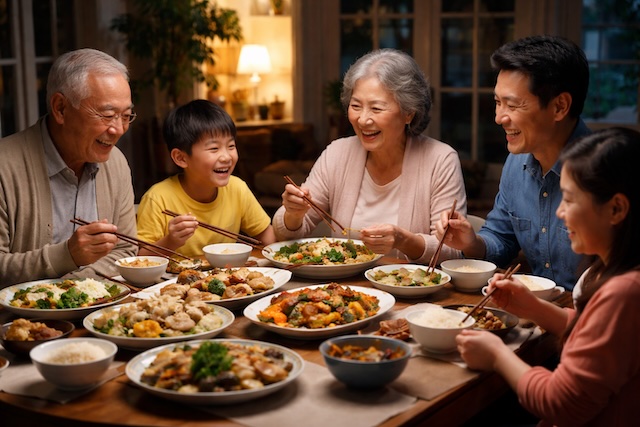
The second way that multi-generational families deem deviate from what we may think of in a stereotypical US household is the family’s oldest living generation residing in the home with their children and even grandchildren.
For us Asian Americans — and specifically Indian Americans in my own experience — this makes perfect sense. Reverence for our elders is one of our most deeply-held beliefs, whether that’s displayed in the way we bend down to touch an elder’s foot when greeting them or refer to them as Aunty or Uncle as a sign or respect.
Asian Americans believe in a tradition of filial piety, and caring for our loved ones as they get older is a way that we display that.
Various studies over the past several decades have consistently shown that relative to our share of the population, Asian Americans live in nursing homes at rates far below White Americans.
It also needs to be said that many instances of elders living with younger generations are actually done to help the children and not the other way around.
Childcare
I’ll never forget my mom’s horrified reaction when her White childhood best friend was recounting a tiff with her mom. The friend’s mom was upset that she’d been asked to do childcare. “You just want me to babysit your kids for free!” she declared, ignoring that “your kids” were the woman’s very own grandkids.
Frankly, I would expect the grandma’s attitude to be shocking to anyone, but especially Asian American families. In my own family, our expectation that my grandmother would want to babysit us came with the same level of certainty with which expected her to drink a cup of chai every afternoon, which is to say 100%.
This was never a burden. It was what she lived for.
Even through the most cynical lens possible if one does believe that such things are transactional, it was my grandmother’s chance to pay forward the childcare assistance that she had gotten from her own parents years earlier.
Ups and Downs
To be clear, I’m not making the claim that AAPI families are, through these traditions, any more close or loving that White families are
In fact, some may even look at the way Asian Americans families communicate with one another and think the opposite: that we come off cold or distant.
I remember an excerpt from actor Simu Liu’s book where he talks about telling his parents that he had been cast as a Marvel superhero, arguably the biggest moment of his life. His parent’s response was effectively “Okay.”
Liu simply laughed at it, noting how perplexed his non-Asian American friends would be by the reaction. But it didn’t mean that they were any less proud of him.
Yes, living multi-generationally in a society where it is not the norm presents its share of challenges from dating to personal space.
But such a culture also brings with it no shortage of enriching experiences.
I’ve watched my 4 year old-nephew learn words in Tamil from the maternal grandparents that spend nearly seven months a year staying with my brother and his wife, largely to assist with child care. The joy that comes from the arrangement is a two-way street for both the child and his grandparents.
My roommate is another example of what we might gain from this culture. It was spending prolonged periods of time with his grandfather that he learned culinary skills that rival that of a professional chef.
I’ll also add that I’m biased in my assessment. My own family is, all things considered, relatively drama free, and I get that not everyone will see spending prolonged time with their family as the same positive that I do.
I do know that there will come a point in my life when I either regret not spending more time with my family or feel grateful for the time that I did get with them. Plus, some pre-folded laundry never hurt.
© 2026 by Asian Media Group Inc.
The benefits for the kids are clear, like free rent or reduced rent and home-cooked meals. And while I’m not necessarily proud of it, I’ll admit that the time I spent living at home in my 20s did include laundry that my mom even folded for me.
Recent Articles
- Micron Forecasts Strong Quarterly Results on Soaring Memory Chip Demand
- Micron and Qualcomm Forecasts Ignite $400 Billion AI Chip Stock Rally
- China Push for Lead in 'Future Industries' Triggers Flood of Venture Capital, Bubble Potential
- 360 Unveils China's Answer to Anthropic’s Mythos
- Venus, Not Mars, Is the Visionary 2nd Earth Play
- Keiko Fujimori's Victory Returns Divisive Dynasty to Peru
- SK Hynix Targets $29 Billion US Listing as AI Demand Surges
- Global Crude Markets Mired in Discounts as Oil Begins Pouring Through Hormuz
- OpenAI Unveils Custom Chip It Designed with Broadcom to Boost Its AI Infrastructure
- US Q1 Current Account Deficit Widened More Than Expected