

Three Indian Sisters' Obsession with Korean Content Proves Fatal
By Romen Basu Borsellino | 19 Feb, 2026
The girls took their lives when their father confiscated their phones in an effort to wean them of their obsession with Korean games, films and music.
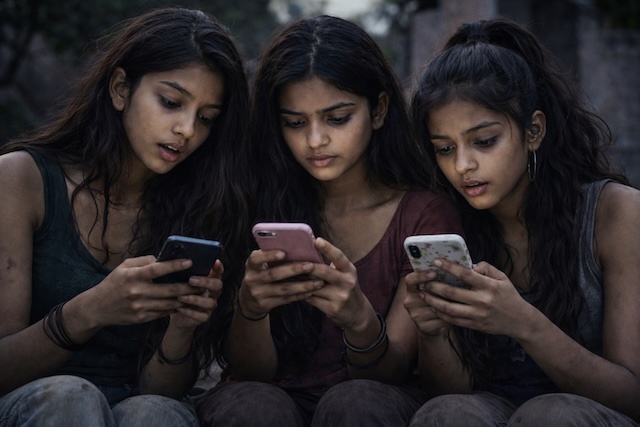
We throw around the phrase “screen addiction” loosely.
My girlfriend accuses me of suffering from it anytime she catches me scrolling Instagram while we’re at dinner or watching a movie or simply chatting. Maybe she’s right that I could unplug a little more.
But then there’s actual screen addition, defined by chronic use of electronics like phones, computers, and gaming consoles. That kind that, like drugs, alcohol, and gambling, can literally ruin lives.

The girls left an eight page letter behind
Tragically, a screen addiction was a primary culprit in the deaths of three young sisters in the Northern Indian State of Uttar Pradesh earlier this month.
According to reporting, sisters Vishika (16), Prachi (14), and Pakhi (12), were so distraught that their parents had taken away their phones that they stepped out onto their ninth floor balcony one night and, one by one, leapt.
That the confiscation of an electronic device could result in not just one but three live-ending decisions of course feels nearly impossible to comprehend.
Even more puzzling perhaps is that screen time was not in and of itself the only culprit for the girls’ downfall. According to the eight-page note that they left behind, an obsession with Korean culture was a primary driver as well.
This is the tragic and almost unbelievable story of sisters Vishika, Prachi, and Pakhi.
The Facts

There is something particularly attractive about the aesthetics of Korean media like Netflix's K-Pop Demon Hunters
It was during the pandemic that the three developed a strong interest not only in Korean video games but K-pop music and Korean dramas. They became fully immersed in Korean culture and even reportedly began using Korean names for themselves. The three eventually discovered the genre of “Korean love game,” which they became engrossed in for roughly three years up until the time of their deaths.
As a result of their extreme addiction to Korean content, the girls reportedly stopped attending school after the pandemic. They became inseparable not only from their Korean content, but from one another as well. They allegedly ate together and bathed together.
It’s fair to say that the three girls were subjected to an unorthodox home life: Their father Chetan Kumar was married to a pair of sisters. Two of the girls were the daughter of one, and the third was their half sister and therefore also their cousin.
While online comments have enjoyed speculating that that father was abusing, there has been no reported evidence.

K-Pop band BTS's appearance on the Tonight Show with Jimmy Fallon set records
And for any faults that Kumar may have had as a parent, it appears to be his attempt to rectify the girls’ addiction that ultimately led to their literal downfall. Kumar took away their phones in an attempt to curb their nonstop contempt consumption.
Just a few days into the confiscation, the girls decided that they could not live without access to Korean content.
The eight page note that the girls left behind came with a preface: “Read everything written in this diary because all of it is true. Read now. I'm really sorry. Sorry, Papa.” The words were sprawled in a combination of both English and Hindu and accompanied by a hand-drawn crying emoji.
According to their father who spoke to reporters in tears, the note said Papa sorry, Korea is our life, Korea is our biggest love, whatever you say, we cannot give it up. So we are killing ourselves.”
According to authorities, the note included the explanation that "You tried to distance us from Koreans, but now you know how much we love Koreans."
Korean Pop Culture
If I’m being honest, it’s tough to recount this story without feeling like I’m blaming Korean culture to some degree. I’m not. No culture has a say in who identifies with them so strongly that they’re driven to suicide.
But I do wonder if there’s something innate about the culture that causes one to feel such a visceral connection to it in the way that these girls did.
It’s well-known by now that Korean entertainment has captured a global audience in ways that little else has.
In the US, for example, the K-Pop band BTS’s weeklong appearance on the Tonight Show with Jimmy Fallon brought in the program’s highest ratings in years. And over the past several months, Netflix’s K-Pop Demon Hunters has shattered records to become the streaming service’s most watched film of all time.
There is, it turns out, a body of research on why Korean media content manages to achieve such a psychological resonance with consumers.
Some have even cited Korean content as a form of soft power — the ability to curry favor through attractiveness rather than coercion — employed by the country. While these theories may be on to something, there is little proof of a sinister motive.
The “attractiveness” of soft power isn’t necessarily meant in the literal physical sense, but it seems to be in this case.
It’s tough to deny that there is something aesthetically pleasing about much of Korean media that simply connects with consumers on a deeply emotional level. Viewers become enthralled —almost mesmerized — by the visual imagery, sound, and aura of the characters.
Listening to, say, the hit K-Pop group BlackPink may not be unlike hearing a politician whose charismatic style can convince an electorate to do nearly anything.
And the visuals of a Korean show or video game might resonate with us in the same seemingly inexplicable way as an ASMR —the euphoric sensation that we get from certain stimuli — video of someone eating pickles close to a microphone .
There's also something to be said about the inclusive nature of Korean pop culture. While Western culture is known for a focus on rugged individualism, K-Pop is largely associated with a feeling of community. Jokes about the sprawling sizes of the most popular bands have even been a subject of jest.
In some ways, this all helps explain the “red scare” of the 1950s. In an effort to stop communism, the American right nearly lost its mind, attacking both figures and aspects of society that did not fit neatly in the American ideal of individualism. It seems as though those at the forefront of this witch hunt were aware of the potent draw of collectivist media on its viewers.
Korean pop culture has allowed consumers to feel a very personal sense of inclusion.
While details about the personal lives of these sisters are relatively scant, it would be unsurprising to learn that they felt socially isolated. Perhaps in K-pop and video games, they felt like they felt a sense of belonging that they had been lacking, especially given that this fixation began during the pandemic, a time when social isolation was mandatory.
Another word that might describe the effect on the content of these sister is: aspirational.
It seems as though the beauty and popularity of those they were fawning over was a reflection of the fans themselves. They allegedly referred to themselves as “Korean princesses.”
Aspirational devotion should be a familiar concept to Americans. It’s a phenomenon that can help explain why so many members of this country’s working class would so eagerly back a billionaire for President. On the surface, it might feel odd to support someone who is out of touch with your everyday struggles. Yet, by being a member of his team, you may be able to tell yourself that his wealth is in some ways your own.
Video Games
While the girls were engrossed in a variety of different Korean content, nothing seemed to have as great of a hold on them as the video games.
I’ll admit that this aspect of the tragedy feels particularly foreign to me. While the games that my friends and I played, from Mario Kart to the less family friendly Grand Theft Auto were not exactly rich in educational value, it’s tough to imagine someone’s inability to live without them.
But I think that’s also a reflection on my inability to grap the ways in which video games have evolved.
According to the Hindustan Times, the types of Korean love games that the girls were into “typically allow the users to select an AI-generated virtual partner, and engage in regular chatting, sharing emojis, or completing daily ‘love challenges’, which gradually builds a sense of intimacy.”
Maybe video games as I know them are not the right comparison. R ather, AI and the effects that it’s had on the minds of young people may be a better explanation.
Multiple ongoing US lawsuits are alleging that AI companies including ChatGPT and Character.AI are responsible for the deaths of Gen Z-ers. In some cases, the AI chatbots stand accused of forming unhealthy relationships that deluded users into a false reality. In others, the bots outright encouraged them to take their own lives, sometimes even instructing them how.
Unbelievable
It’s been well under a month since this tragedy occurred, and there are likely still plenty of important details that are yet to be discovered or have simply not been made public.
To call this all unbelievable might be an understatement.
But then again, it might be easier to live in disbelief than imagine that this sort of thing could happen to anyone we personally know.
We will likely tell ourselves that only a particularly unique set of circumstances involving these specific girls could allow this to happen. And that may very well be the case.
But until we know for certain, this should serve as a wake-up call.
© 2026 by Asian Media Group Inc.
That the confiscation of an electronic device could result in not just one but three live-ending decisions of course feels nearly impossible to comprehend. Even more puzzling perhaps is that screen time was not in and of itself the only culprit for the girls’ downfall.
Recent Articles
- CXMT Wins $3 Billion Memory Supply Deal with Tencent
- Geely to Ship First Lotus EVs to Canada in July Under Carney-Xi Deal
- Soaring Bills Reshape How Businesses Choose Models
- Samsung, SK Hynix to Anchor $576 Billion AI-chip Drive to Cement Korea's Global Leadership
- S. Korea's 'Mega Projects' Center Around Chips, Data Centers and Robotics
- Trump’s Tariffs Aren’t Saving Jobs at Whirlpool’s Iowa Refrigerator Plant
- US Supreme Court Rebuffs Trump's Appeal in E. Jean Carroll Case
- S. Korean Exports Grow Fastest in Nearly 50 Years
- South Korean President to Unveil Massive AI and Chip Investment Drive
- Philippines Leads World in Solar Installs as Power Prices Soar