

2 Asian Immigrants Were Behind "Alien" Fiber Optics Technology
By Goldsea Staff | 21 Jan, 2026
The pioneering work of Narinder Singh Kapany and Charles Kao laid the groundwork for fiber optics technology which some believe was reverse-engineered from a UFO that crashed in Roswell, New Mexico in July 1947.
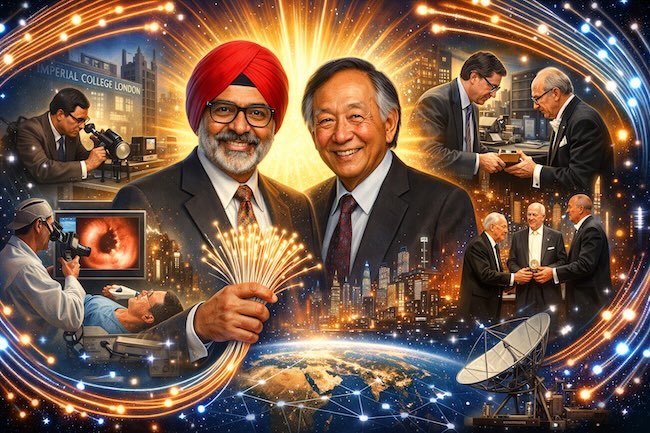
(Image by ChatGPT)
Global internet connectivity and high-speed telecommunications are taken for granted today. But the science and technology enabling these conveniences took several decades of painstaking research by two generations of scientists. The two pioneers who were central in taking the first big steps toward transforming fiber optics from a curious scientific phenomenon into the backbone of modern communications are Narinder Singh Kapany and Charles Kao.
Fiber optics had been a subject of research long before either Kapany or Kao entered the field. The basic principle had been demonstrated As early as the 1840s and 1850s physicists had demonstrated that transparent materials could guide light down a path. But these early demonstrations were little more than curiosities. The real challenge lay in making this phenomenon useful for transmitting information over meaningful distances.
Narinder Singh Kapany's contributions to fiber optics emerged in the early 1950s while he was working at Imperial College in London. Born in Punjab, India in 1926, Kapany had come to Britain to pursue advanced studies in optics. At Imperial College he collaborated with Harold Hopkins, and together they tackled one of the fundamental challenges in optical fiber transmission: how to transmit clear images through bundles of thin glass fibers.
In 1953 Kapany and Hopkins achieved a breakthrough by demonstrated good image transmission through a large bundle of optical fibers for the first time. This wasn't simply about getting light from one end of a fiber to another; it was about maintaining the spatial relationships of light patterns so that coherent images could be transmitted. Each individual fiber in the bundle carried a tiny portion of the overall image, and when assembled, these fibers could transmit recognizable pictures.
After completing his PhD at Imperial College London in 1955 Kapany moved to the United States. He worked as a research scientist first at the University of Rochester in New York and later at the Illinois Institute of Technology in Chicago making numerous contributions to the practical application of fiber optics. One was medical imaging devices like endoscopes, which allowed doctors to see inside the human body without invasive surgery. Kapany also coined the term "fiber optics" in a 1960 article for Scientific American.
Kapany's work showed the potential of fiber optics to transmit images over short distances. But the concept of using optical fibers for long-distance telecommunications wasn't seriously accepted due to the problem of signal loss, or attenuation. The glass fibers of the 1950s and early 1960s caused so much loss of intensity over even modest distances that the technology seemed impractical for communication networks. This barrier caused most experts of the era to believe that optical fibers would never be suitable for telecommunications.
Charles Kao was an exception. Born in Shanghai in 1933 and raised in Hong Kong, Kao pursued his education in electrical engineering in Britain. In the 1960s. He was working at Standard Telecommunication Laboratories, a research facility based in Harlow, Essex owned by ITT Corporation. There, while simultaneously pursuing a PhD in Electrical Engineering at University College London as an external student, Kao questioned the fundamental limitations of optical fiber transmission.
Doubting the prevailing wisdom that glass itself was inherently too lossy for long-distance light transmission, Kao conducted careful theoretical analysis and experimental work with colleague George Hockham. In 1966 he concluded that the high signal loss in existing optical fibers wasn't due to fundamental properties of glass but due to impurities in the glass material itself. Glass manufactured with sufficient purity, Kao argued, would lower attenuation levels in optical fibers to make long-distance telecommunications feasible.
This was a transformative insight. If glass could be purified to reduce attenuation to below 20 decibels per kilometer, Kao calculated, fiber optic cables might even surpass existing copper telecommunications cables. At that time existing fibers had attenuation rates of around 1,000 decibels per kilometer, making his target seem wildly optimistic to many skeptics.
But Kao's published study laid out both the problem and the solution with such clarity that they galvanized research efforts worldwide. Glass manufacturers, particularly Corning Glass Works in the United States, took up the challenge. In 1970, just four years after Kao's seminal paper, researchers at Corning succeeded in producing optical fiber with attenuation below the crucial 20 decibels per kilometer threshold identified by Kao. This validated Kao's vision and opened the floodgates for commercial development of fiber optic telecommunications.
The complementary nature of Kapany's and Kao's contributions is striking. Together they laid the foundation for modern fiber optic networks that carrying vast amounts of data across continents and oceans at the speed of light. The internet itself, streaming services, international phone calls, and countless other modern conveniences depend on fiber optic cables.
In recognition of his groundbreaking work, Charles Kao was awarded the Nobel Prize in Physics in 2009. Narinder Singh Kapany never received the Nobel Prize but is widely recognized as the "father of fiber optics" and was named one of the seven "Unsung Heroes" by Fortune magazine in their assessment of twentieth century innovators.
© 2026 by Asian Media Group Inc.
Recent Articles
- Charles Schwab Working with Cboe to Enter Prediction Market
- Mexico's Love Affair with All Things Korean — Until Thursday's Kickoff
- The Making of a Striking Tiger
- Japan's World Cup Prospects Brighter Than Their Single Group Point Might Suggest
- International Stars in the Red Devils' Lineup Suggests a Deep World Cup Run for S. Korea
- Italy's Meloni Says Trump 'Totally Invented' Story That She Begged Him for Photo
- Lebanon Ceasefire Agreed After US-Iran Talks in Switzerland Scrapped
- Qantas Bets on Sleep and Light Science to Sell 20-Hour Flights
- High-Wire Diplomacy Delivered US-Iran Deal but the Tricky Part's to Come
- Pentagon Asks for $80 Billion for Iran War Bills