

American Dishes That Best Nutritionally Complement East and South Asian Diets
By Goldsea Staff | 02 Jan, 2026
If you've ever wondered how to best balance nutritional deficiencies in your routine Asian diets, take a look at these dishes.
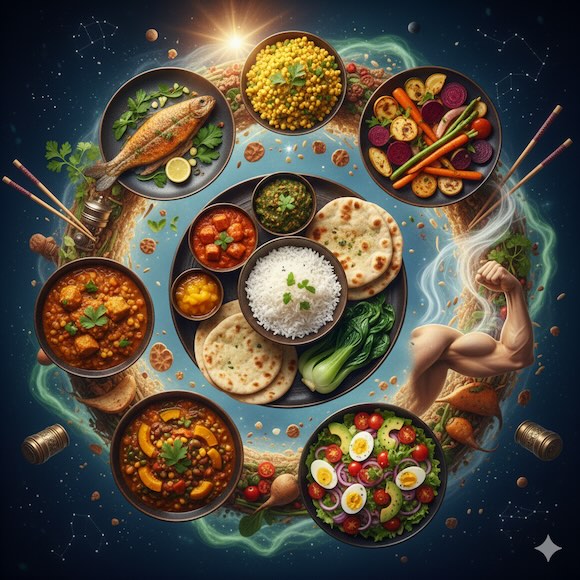
(Image by Gemini)
As much as we love our Asian meals, they aren't always available, especially when work takes us away from home or our favorite restaurants. At times like that we try to eat meals that provide the best nutritional complements to our usual east or south Asian diets.
Traditional East Asian diets can be lower in calcium and fiber when white rice is the staple, while traditional South Asian diets can be high in refined carbohydrates and saturated fats from ghee or frying.

(Image by Gemini)
Here are 10 American dishes that fill these gaps while respecting the flavor profiles and ingredients familiar to these regions.
To Complement East Asian Diets
Focus: Increasing Calcium, Fiber, and Vitamin D.
1. Grilled Salmon with Asparagus — High in Omega-3s and Vitamin D.
Complements the seafood-heavy nature of East Asian diets while providing Vitamin D, which can be lower in urban East Asian populations.
2. Kale & Quinoa Salad — Rich in Calcium and Fiber.
Provides a significant fiber boost to offset white rice consumption and offers plant-based calcium often missing without dairy.
3. Roasted Brussels Sprouts — High in Vitamin Kand Fiber.
The "umami" from roasting (especially if glazed with a bit of balsamic or maple) pairs perfectly with savory soy-based dishes.
4. Turkey & White Bean Chili — High in Lean Protein and Soluble Fiber.
Uses beans (less common in East Asian mains) to improve gut health and provides a lean alternative to pork.
5. Wild Rice Pilaf — High in B-Vitamins and Fiber.
A "true" American grain that is nutritionally superior to white rice, offering a chewy texture that appeals to rice lovers.
To Complement South Asian Diets
Focus: Reducing Glycemic Load, adding Lean Protein, and Healthy Fats.
6. Succotash (Corn & Lima Beans)— Complete Protein & Low Glycemic.
This Native American staple combines legumes and corn to create a fiber-rich side that prevents the blood sugar spikes common with white flour rotis.
7. Baked Trout or Walleye — Heart-Healthy Fats (Unsaturated).
South Asian diets can be high in saturated fats; swapping a fried dish for baked freshwater fish provides essential fatty acids.
8. Roasted Root Vegetables — Complex Carbohydrates (Low GI).
Swapping white potatoes for roasted carrots, parsnips, and beets provides better glycemic control while remaining "comforting."
9. Garden Cobb Salad (No Bacon) — High in Potassium and Vitamin A.
The inclusion of avocado provides healthy monounsaturated fats, and the fresh greens help balance the "cooked-through" nature of many curries.
10. Three Sisters Stew — Fiber and Plant Protein.
A traditional blend of squash, corn, and beans. It is naturally vegan/vegetarian, making it an easy addition to meat-free South Asian meals.
Nutritional Strategy Summary
For East Asian Palates: Look for American dishes that incorporate dark leafy greens and beans to increase fiber and calcium.
For South Asian Palates: Focus on baking/roasting instead of frying, and use legumes (like lima or kidney beans) as a centerpiece to slow down carbohydrate digestion.
© 2026 by Asian Media Group Inc.
Recent Articles
- Keiko Fujimori Edges Ahead in Brutal Contested Vote Count
- Chip Queen He Tingbo Subverts Moore's Law to Overturn the Global Semiconductor Hierarchy
- Only 30% of Americans Consider the US the World's Greatest Country
- US Spends $25,000 a Month to Store Unusable Contraceptives Stuck in Belgium
- AI Optical Parts Maker Zhongji Innolight Eyes $7 Billion Hong Kong Listing
- US-Iran Peace Deal Kicks the Can Down the Road
- Surging SpaceX Set to Overtake Amazon in Market Value
- US Annual Import Price Rise Highest in 4 Years
- Humbled Trump Points to 'No Nukes' Fig Leaf in Half-Baked Deal
- SpaceX Locks in $60 Billion Cursor Deal to Power AI Coding Push