

Fusion Is Smart Science But a Dumb Energy Bet
By Tom Kagy | 25 Dec, 2025
As an economical global energy source fusion power's future is fast receding into the past.
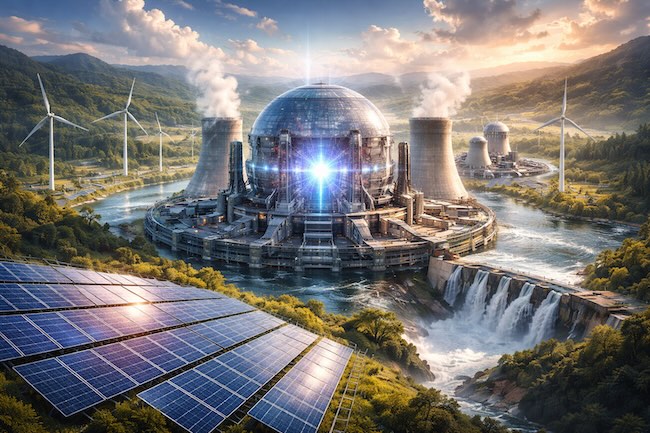
(Image by ChatGPT)
For more than 70 years nuclear fusion has claimed a privileged place in humanity’s technological imagination. And with good reason—from the scientific standpoint. After all, it is the closest humanity will come to modeling the physics underlying our sun, the ultimate source of virtually all energy on planet earth.
It's the clean, limitless, safe energy that's always stays 30 years away, as the old joke from the 1990s goes. Even tdday, after the fundamental science of fusion energy has been borne out in recent years with net power output, the fusion as a commercial energy sources is still 30 years away!
Venture capitalists now sell it as the ultimate deep-tech play. And it gained a resurgence of interest after Trump Media exchanged shares with Google's TAE in a quest to profit from the quest to commercialize fusion power—an effort at bolstering technological fog with political fog. But seen through the cold, clear lenses of economics, timelines, opportunity cost, and competing technologies, fusion begins to look less like humanity’s energy savior and more like the most spectacular misallocations of capital in modern history.
To be sure, fusion works. We have been fusing atoms in laboratories for decades. But as a viable commercial rival to proven cheap, clean and safe alternatives, fusion will simply be arriving far too late to be competitive.
Fusion’s initially bright appeal originated in a vastly different era. When serious fusion research began in the 1950s and 1960s humanity faced a stark choice: burn fossil fuels indefinitely or unlock a fundamentally new source of energy. Solar was niche and expensive. Wind was unreliable and small-scale. Batteries were laughable. Computing power was scarce. Grid coordination was crude.
In that context, a dense, centralized, always-on energy source seemed irresistible.
That was then.
Today solar energy is the cheapest form of electricity ever produced by humans. Battery costs have fallen more than 90 percent in three decades. Grid-scale storage is scaling across multiple chemistries. High-voltage direct current transmission moves power thousands of miles with minimal loss. AI optimizes demand and generation in real time. Overbuilding generation is cheaper than precision engineering.
Fusion's hope as a commercial energy source has been kept alive by misleading headlines announcing “net energy gain” or record plasma temperatures. These are meaningful breakthroughs scientifically but have become irrelevant milestones economically. Why? While the physics of fusion has been amply demonstrated, it still lacks the technology to turn it into a continuous, predictable and cheap energy source that lasts decades.
A commercial fusion plant must simultaneously:
Maintain plasma stability at temperatures hotter than the Sun
Survive relentless bombardment by high-energy neutrons
Breed and handle radioactive tritium fuel internally
Operate with uptime comparable to modern power plants
Replace components at intervals that don't break the bank
Each of these is brutally difficult. Collectively, they stamp an expiration date on fusion as a commercial energy source, at least for the next half century.
The toughest to solve is the problem of durable materials that can withstand neutron damage for decades. Simulating decades of radiation exposure requires, well, decades of experimentation that can't be simulated. That alone pushes true commercial fusion deep into the mid-to-late 21st century.
Solar and wind benefit from manufacturing learning curves. Every panel produced and every turbine installed makes the next one cheaper. Batteries benefit from chemistry, scale, and supply-chain optimization. Storage technologies diversify and compete. Grids become smarter and more interconnected.
Fusion energy benefits from none of these constantly improving efficiencies.
Each fusion reactor is a bespoke cathedral of extreme engineering. Fusion plants look more like aircraft carriers than solar farms. They don't get dramatically cheaper with repetition the way silicon wafers or battery cells do. Fusion generator components are custom, regulated, and irreplaceable without massive downtime.
By the time fusion becomes viable the world will be saturated with cheap renewable capacity and storage. Fusion is no longer competing against coal or gas. It's competing with electricity whose marginal cost is approaching zero—an impossible market in which to gain a toehold even after all of fusion's tech issues have been ironed out.
For all practical purposes fusion research remains basic science, perhaps worth it in terms of knowledge gained but not competitive in terms of investment capital that could be going to build massive HVDC supergrids, deploy long-duration storage, expand geothermal drilling, scaling safe advanced fission, electrifying industrial heat, and reducing demand through improved efficiency. These are all investments that can generate certain returns within years, not generations.
At this point it seems clear that fusion, when it finally arrives, will be a technological triumph but an economic footnote. Meanwhile, unglamorous solar panels, batteries, wires, drills, and software will have quietly solved our energy problems. It's not dumb to believe fusion is possible—as one day it will be—but in believing fusion is necessary.
© 2025 by Asian Media Group Inc.
Recent Articles
- Newsom Says Trump Sending Agents to Homes of Friends, Family
- North Korea Touts Industrial ‘Miracles’ as Output Exceeds Targets
- Global EV Registrations Rose 3% in May
- China's Industrial Output Grew Faster in May but Retail Sales and Investment Slowed
- Asia Markets Temperate in Assessing Likely Delayed Impact of Iran Deal
- Japan's Auto Shops Unlikely to See Quick Relief from US-Iran Deal
- Hermanos Coreanos, Clarkson Crowned, Jung Hoo Lee Sets Record
- California Congressman Dave Min Presses Trump on “Pay-To-Play” Pardons
- China's Heavy Truck Electrification to Hit Diesel Demand
- Trump Push into Highly Dangerous Plutonium Unlikely to Fix US Nuclear Fuel Crunch