

Headlines, Oil and the Death of American Morality
By Tom Kagy | 01 Dec, 2025
The murders of innocent Venezuelan fishermen under the pretext of stopping drug traffickers is such a blatant violation of human rights that America itself is becoming blood-stained.
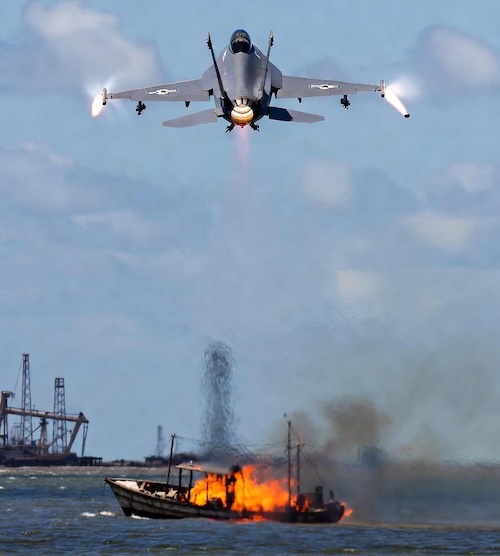
(Image by Grok)
Venezuela plays no role in the fentanyl pipeline that actually kills Americans. Nearly all fentanyl enters through legal ports of entry hidden in trucks and cars from Mexico. Cocaine, the drug these boats allegedly carry, arrives overwhelmingly through Colombia and Central America, not the eastern Caribbean.
These are undisputed facts.
And the boats that were destroyed by US missiles contained no evidence of narcotics. Some were fishing boats whose crews happened to be in the wrong patch of international water when an American missile arrived. In at least one documented case, survivors swimming from a burning hull were deliberately targeted in a second strike.
Yet the White House calls the fishermen cartel operatives while Trump celebrates the cold-blooded murders and by posting fireball videos on Truth Social. The only conceivable rational motivation might be an effort to distract from the enduring Epstein scandal that continues to threaten Trump's standing with his MAGA base.
But Trump has never been accused of being rational. To his mind blowing up boats is easy and cheap, visually dramatic, and impossible to fact-check in real time. Each strike is announced with a body count and a lurid claim (“This one boat would have killed 25,000 kids”), random fictional numbers repeated by friendly outlets. The formula worked in the 1980s with Grenada, in the 1990s with Sudan and aspirin factories, and it works again in 2025. Congress asks uncomfortable questions, but the footage is already viral and the next explosion is only days away.
Beneath the pyrotechnics lies the more enduring prize: oil. Venezuela sits on the largest proven petroleum reserves on earth, more than Saudi Arabia and Iran combined. For decades American companies pumped it, refined it, and sold it at enormous profit. Hugo Chávez ended that arrangement, and Nicolás Maduro—however incompetent—has kept the oil nationalized.
In interviews before his second term Trump spoke openly of Venezuela “giving” its oil to China while America suffered high prices. “We could take it if we wanted,” he said in 2023, “they’re weak.” The boat attacks are the opening act of a pressure campaign designed to make Maduro weaker still.
That weakness proved irresistible to Trump who has shown himself to be bold in attacking the weak. Venezuela is an impoverished, barely functioning nation deeply in debt to China. It has no military capable of mounting a threat to the US. For someone like Trump, it's the perfect target to bully with slogans that gratify his MAGA base: "Death to drug traffickers!" "We'll take their oil as payback."
Trump appears to have set the plan in motion to destabilize Venezuela with the revocation of Chevron’s license in March 2025 which crashed Venezuelan export revenue. When Caracas turned to Beijing for rescue, Chinese firms stepped into the vacuum left by departing Western majors. Trump then designated the Cartel de los Soles a terrorist organization — conveniently ignoring that the same accusation could have been made any time in the last twenty years —and declared open season on any vessel that might conceivably be linked to it.
The naval task force parked off Venezuela’s coast grew larger by the month. By November, American warships were shadowing tankers bound for China, and Trump was publicly musing about “going ashore” if the drug flow did not stop.
This is not a war on drugs; it is a war on a government that refuses to sell its birthright at fire-sale prices. The United States does not need Venezuelan heavy crude—domestic production is at record highs and the Strategic Petroleum Reserve is full—but American oil companies and their political sponsors very much want it. A collapsed or compliant regime in Caracas would hand multibillion-dollar contracts to Exxon, Chevron, and their friends, just as Iraq’s oil fields were handed out after 2003. The boat attacks are the low-cost, high-drama way to soften the target before the real negotiations—or the real invasion—begin.
China, predictably, has taken notice. Beijing has already invested tens of billions in Venezuelan fields and infrastructure, accepting oil as repayment for loans Washington forced into default. Every American missile that lights up the night strengthens China’s argument to Maduro: only we will stand with you when the gringos come. The irony is bitter. Trump’s belligerence is pushing the very oil he covets into Beijing’s hands faster than any diplomatic blunder could have managed.
A century ago the United States sent marines into half a dozen Latin American countries to protect fruit companies and collect debts. Today the pretext is fentanyl and the weapons are million-dollar missiles instead of gunboats, but the impulse is identical: a weaker neighbor has something America wants, and force, wrapped in moral rhetoric, is the quickest way to get it.
The Venezuelan boat attacks aren't about saving American lives but about producing viral videos for domestic consumption. They're the opening salvos of a campaign whose real target is not a few dozen traffickers in leaky speedboats but the greatest untapped oil reservoir on the planet. All the while distracting the MAGA base from the festering and inflamed Epstein scandal. Everything else—the body counts, the terrorist designations, the righteous language, the lure of cheap Venezuelan oil—is distraction from Trump's grotesque failures with the economy and the scandal that could drive the nails in the coffin of a GOP-controlled congress. In other words, the murders are pure evil, and it taints all Americans for continuing to countenance an unprincipled and murderous leader.
© 2025 by Asian Media Group Inc.
Recent Articles
- Newsom Says Trump Sending Agents to Homes of Friends, Family
- North Korea Touts Industrial ‘Miracles’ as Output Exceeds Targets
- Global EV Registrations Rose 3% in May
- China's Industrial Output Grew Faster in May but Retail Sales and Investment Slowed
- Asia Markets Temperate in Assessing Likely Delayed Impact of Iran Deal
- Japan's Auto Shops Unlikely to See Quick Relief from US-Iran Deal
- Hermanos Coreanos, Clarkson Crowned, Jung Hoo Lee Sets Record
- California Congressman Dave Min Presses Trump on “Pay-To-Play” Pardons
- China's Heavy Truck Electrification to Hit Diesel Demand
- Trump Push into Highly Dangerous Plutonium Unlikely to Fix US Nuclear Fuel Crunch