

Racism Went Official in Shasta's Shadow
By Romen Basu Borsellino | 15 Jan, 2026
A Northern California Hmong refugee community seeks justice for a decade of racial harassment by local authorities using marijuana and water as legal pretexts.
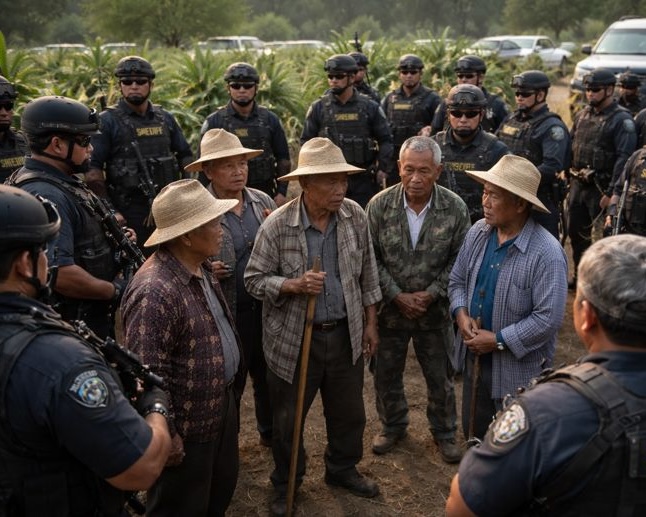
Asian Americans account for just 2.4% of the population in Northern California’s Siskiyou County, and yet they have been the target of 28% of all traffic stops.
For years now the area's 4,000 or so AAPI residents — nearly all Hmong refugees — have alleged systematic racism on the part of county government and law enforcement.
Just weeks ago, the county and the Hmong community reached a settlement, marking the latest just another step in a seemingly never-ending saga that involves weed, water, and a White versus Asian American divide.

The Hmong are an indigenous people, many of whom fled to Thai refugee camps following the Vietnam War
The Vietnam War
The Hmong are an indigenous group of East and Southeast Asians covertly enlisted by the CIA to fight North Vietnam during their invasion of Laos in the 1960s.
It has been alleged that the CIA gave them little choice, presenting them only with the options of fighting for us or dying.
At the completion of the Vietnam War, payback against the Hmong — seen as traitors for helping the US — was swift. To avoid slaughter, survivors fled to Thai refugee camps. From these about 90% would ultimately migrate to the US in one of several waves over the next few decades.
By the 2020s the US would become home to approximately 360,000 Hmong Americans, which accounts for about 1.7% of the country’s AAPI population. About one-third of them are located in California.

Farmland in Siskiyou County, CA
2014
While the vast majority of California's Hmong refugees initially arrived in the Central Valley, many began moving to the state’s Northern region around 2014 in hopes of making a living in farming. The Hmong were, after all, prolific farmers in Asia, particularly of opium.
Marijuana cultivation in California seemed like a logical way to make use of their opium farming skills and earn a livelihood, particularly given the abundance of cheap land and lessening of negative attitudes towards the drug. The problem is, marijuana cultivation wasn’t exactly legal in California yet.
While the Hmong had little issue adapting to some Northern California counties like Trinity, where their initial presence pre-dated their involvement in marijuana, their arrival in neighboring Siskiyou county, double the size of Trinity, was a different story.

Elected have set out to destroy the unlawful marijuana plants being grown in Siskiyou
The Hmong’s relationship with Siskiyou was fraught from the start, with the town’s almost all-white establishment viewing them as criminals coming in to steal their resources while breaking their laws.
To the Hmong, any hostility directed at them was overwhelmingly punching down.
Per Hmong residents, the rural outpost of Shasta Vista where they resided was “garbage land.”
Siskiyou County Sheriff Jon Lopey, one of the Hmong’s biggest antagonists, described their living conditions as rife with “Garbage, human waste — you have shacks, you have ramshackle trailers being moved into these communities."
Stores would reportedly refuse to sell goods to the Hmong, and according to some Hmong residents, White residents would flip them off as they walked by.
And law enforcement were regularly raiding their homes in search of illegal marijuana growing activity.
2016
In September 2016 Hmong residents took legal action against the county in Vang et al. v Lopey.
While growing marijuana wasn't universally illegal in the state of California, Siskiyou County had effectively made it so in the areas where the Hmong had been known to grow it. This was done by the passage of ordinances T and U, which appeared on the June 7, 2016 ballot.
The Hmong alleged that the new anti-marijuana ordinances “gave Sheriff Lopey unfettered power to target Hmong homeowners” and that enforcement of the ordinances disproportionately affected Hmong residents.
The plaintiffs also alleged the the ordinances were passed through illicit means. They alleged voter intimidation tactics by the county, and that officers armed with assault rifles had come to Hmong property ahead of the election, to tell them that they would be breaking the law if they attempted to vote
It was, the plaintiffs said, reminiscent of the violent threats that they had faced in Vietnam over their work with the US.
The lawsuit was dismissed by a federal judge.
2020
The 2016 ordinance seemed to have little impact on curbing the illegal cultivation of marijuana, which the country now likened to the operation of a drug cartel.
In 2020 Northern California entered an historic drought that helped bring tensions in Siskiyou to an all time high.
A water shortage was blamed on the marijuana farmers. The county took drastic measures, including banning the transportation of large amounts of water on certain county roads.
But the ban effectively targeted just one area, which happened to be 75% Hmong. That area also lacked a centralized water system which meant that residents relied on the transportation of outside water for basic everyday needs.
Residents reported constantly being thirsty and only being able to bathe once a week. Farmers were unable to water their crops and their animals were dying of thirst.
The county also made it illegal for businesses and other locals to provide water to those in the targeted area. They sued a local landowner for letting residents use his private well.
While the ban may have been effective at curbing marijuana cultivation, it did so by depriving those in the area —whether involved in illegal activity or not — of basic human rights.
So Hmong residents once again sued. In June 2021, ACLU of Northern California and the Asian Law Caucus joined in filing briefs on their behalf.
Two months later on August 6, US District Court Judge Kimberly Mueller ordered both affected parties —the county and the targeted Hmong residents — to enter a mandatory mediation.
The purpose of the mediation, Judge Mueller states, was to “ensure people living in the Mount Shasta Vista subdivision have water to meet their basic needs while the court considers the pending motion for a preliminary injunction.”
Today
Just last month, Siskiyou County’s Hmong population got its biggest taste of justice yet. As part of a settlement, the county has agreed to policing reforms and independent oversight.
The reforms agreed to by the county’s board of supervisors and sheriff’s office will pertain in part to traffic stops, which the Hmong community attests have been used as a tool of incessant harassment and discrimination against them.
The Sheriff’s office has agreed to adopt a policy that bans race-based traffic stops as well as stops made solely because the driver has out of state license plates or is simply driving through high crime areas.
Additionally officers must activate body cameras during any search, state their reasoning for a stop, and provide an interpreter for non-English speakers. The county will also stop issuing property liens to collect unpaid cannabis fines.
To ensure enforcement of these reforms, the country will hire an independent auditor to monitor compliance and hold community meetings each year.
Water access, which is at the heart of the lawsuits, remains in litigation.
It's worth noting that this isn't a question of whether the law has been broken through the illegal cultivation of marijuana. Allegations made by the county about the extent of damage that has been inflicted through this drug operation may very well be true.
The question is whether or not the ends justify the means, whether the crime of cultivation is so grave that authorities must strip away the lawful rights of an ethnic community in an effort to curb it.
Unfortunately, the same question seems to be coming up not just in Siskiyou county, but in nearly every pocket of this country.
While the ban may have been effective at curbing marijuana cultivation, it did so by depriving those in the area —whether involved in illegal activity or not — of basic human rights. So Hmong residents once again sued
Recent Articles
- Job Openings Fell in March but Hiring and Layoffs Surged
- Musk Wanted $80 Billion to Colonize Mars Testifies OpenAI President
- Nasdaq Hits Record on Surging AI Chip Stocks
- Anthropic's Deep Push into Finance Tasks Likely to Disrupt Software Sector
- 'Yaris Moment' in the Works for Chinese Carmakers Chasing Overseas Growth
- Volvo's Q1 Full-EV Sales Rose 14% in Challenging Market
- Hong Kong Q1 GDP Expanded Fastest in Nearly Five Years
- Hugo Boss Beats on Profit Despite Iran
- PayPal Q1 Beats on Top Line on Spending by Affluent Consumers
- Coinbase Cuts Workforce on Crypto Market Volatility