

Daily White House Orders to Military Presage Constitutional Coup
By Tom Kagy | 21 Dec, 2025
Is Trump preparing for a day when military backing will cement his rise to absolute power?
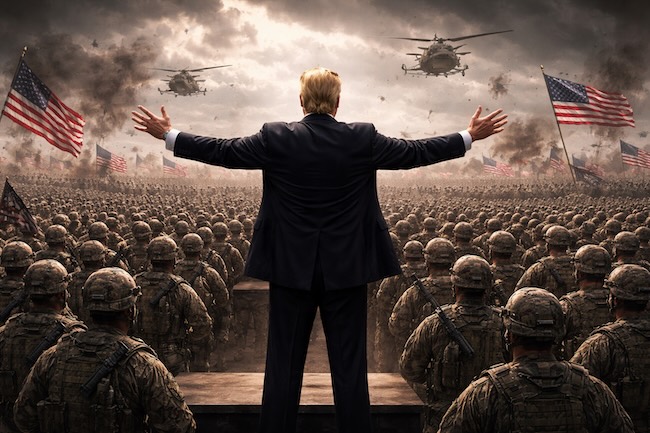
(Image by ChatGPT)
In constitutional democracies control of the military is carefully checked and channeled to safeguard against the concentration of coercive political power. These safeguards are now under direct assault by the nearly daily series of military mobilizations ordered by Trump under laughable "national security emergency" pretexts to militarize American cities and to attack foreign nations in the absence of a formal declaration of war.
The United States has long relied on constitutional provisions, laws, customs, and professional ethics to ensure that the armed forces remain insulated from partisan politics. Against this backdrop, any effort to routinize direct, frequent, or personalized White House orders to the military—especially outside established chains of command and legal frameworks—demand hard and urgent scrutiny by the other co-equal branches of government — as well as the by individual states and a vigorous free press. Such practices are closely consistent with preparatory steps historically associated with constitutional coups: the gradual normalization of exceptional authority, the blurring of legal boundaries, and the cultivation of personal loyalty within the military chain of command.
A constitutional coup differs from a military putsch. Tanks don't roll through capitals—though Trump does seem to take inordinate delight in creating such events. Legal forms are preserved while their substance is hollowed out. Power is consolidated through procedural manipulation, emergency rationales, and the steady erosion of independent institutions. Courts may remain open, elections may still occur, and legislatures may still meet, but the balance among branches is altered in ways that make reversal difficult. In this model, the military’s role is less about overt seizure of power and more about deterrence, signaling, and enforcement. Ensuring that the armed forces are habituated to receiving direct political direction is therefore a critical enabling condition.
The US Constitution wisely interposes buffers between the president and operational military control. While the president is commander in chief, lawful orders flow through the secretary of defense and the established chain of command under explicit constraint of the Constitution, statute, the Uniform Code of Military Justice and professional norms. This architecture ensures deliberation, creates accountability, and provides space for legal review. It also insulates the military from the whim of any individual officeholder. Routinizing daily White House orders—particularly if framed as informal guidance, loyalty tests, or ad hoc directives of the Trump variety—would undermine these buffers by shifting expectations about where authority truly resides.
History suggests that coups are rarely sudden. They're prepared through repetition. When extraordinary actions become routine, resistance weakens. If military leaders are conditioned to expect frequent, personalized direction from the White House, the distinction between lawful command authority and political instruction can erode. Over time, officers may internalize the idea that responsiveness to the president’s immediate wishes is the paramount professional virtue, even when those wishes violate statutory or constitutional limits. This isn't a hypothetical concern; it's a pattern observed in multiple countries that suffered democratic backsliding without dramatic breaks in legality.
A key hallmark of constitutional coup preparation is the selective activation of emergency or domestic-security rationales. The United States possesses a vast array of statutes that allow the president to deploy the military domestically under certain conditions, from the Insurrection Act to disaster-response authorities. These powers are intended to be exceptional and narrowly tailored. Normalizing daily White House-military interaction risks lowering the psychological and institutional threshold for invoking such authorities. If routine deployment of the National Guard is established, escalating to more intrusive and political orders can appear colorably legitimate rather than alarming, limiting institutional resistance.
Equally important is the effect on civil-military norms. The U.S. armed forces are trained to be apolitical, loyal to the Constitution rather than to any individual. This ethic is reinforced by isolation from day-to-day politics. Regularized White House orders, especially if publicly framed as demonstrations of strength or resolve, would pull the military closer to partisan engagement. Even if officers scrupulously avoid political expression, the perception of politicization can damage public trust. Once trust erodes, the military’s presence in domestic disputes can become both more likely and more destabilizing.
Comparative experience is instructive. In several democracies that slid toward authoritarianism in the twenty-first century, leaders did not initially purge or openly defy the military. Instead, they cultivated habits of direct engagement, bypassed intermediaries, and rewarded personal loyalty. Over time, legal interpretations were stretched, oversight weakened, and resistance framed as insubordination. The military’s institutional identity subtly shifted from guardian of the constitutional order to guarantor of executive stability. In many cases, no single order was illegal on its face; the danger lay in accumulation.
In Russia Vladimir Putin cultivated habitual presidential direction of security forces, eroding constitutional checks without a classic coup. In Turkey Recep Tayyip Erdoğan steadily expanded personalized oversight of the armed forces after the 2016 coup attempt, normalizing executive decrees and purges. This led to a constitutional transformation that centralized power in the presidency while neutralizing military autonomy. Venezuela offers a clearer arc: Hugo Chávez routinized ideological and operational control of the military, paving the way for Nicolás Maduro to retain power despite constitutional collapse. In Egypt repeated presidential-military coordination under Abdel Fattah el-Sisi culminated in a military-backed overthrow of civilian rule. In each case, habituation—not sudden illegality—proved decisive.
In the American context routinized White House orders would also strain the role of Congress. Legislative oversight of the military depends on transparency, regular reporting, and the predictability of command structures. Informal or personalized directives are harder to track and scrutinize. They can be justified as executive privilege or operational necessity, narrowing the space for meaningful review. This dynamic mirrors a broader feature of constitutional coups: the sidelining of legislatures not through dissolution but through procedural opacity and speed.
Defenders of closer presidential control might argue that modern threats require agility and unity of command. Yet agility doesn't require informality, nor does unity require personalization. The existing system already allows for rapid decision-making while preserving legal safeguards. What routinization adds isn't efficiency but habituation—an adjustment of expectations about who gives orders, how often, and with what degree of justification. That adjustment, in turn, reduces friction at precisely the moments when friction is constitutionally valuable.
The symbolic dimension is worth noting. Democracies rely on symbols as much as on statutes. The image of the military as a neutral institution matters. Regularized displays of presidential direction, especially if accompanied by rhetoric emphasizing loyalty or obedience—like Trump's recent declaration that lawmakers who urge the military to disobey illegal orders should face the firing squad—weakens that neutrality.
Daily White House orders to the military weaken intermediating institutions, recalibrate professional norms, and normalize exceptional authority. In a moment of crisis—whether real or manufactured—these changes could enable rapid consolidation of power with minimal resistance. By the time formal lines are crossed, the habits required to resist may have been demolished. In other words, if and when Trump decides to go completely rogue, he may well be able to back his coup with the power of the armed forces.
Safeguards exist precisely to prevent this outcome. Clear adherence to established chains of command, rigorous legal review of orders, robust congressional oversight, and a reaffirmation of the military’s constitutional oath are not bureaucratic niceties. They are the infrastructure of democratic resilience. Preserving them requires vigilance not only against overt illegality but against practices that, while colorably lawful in isolation, align too closely with preparation for a constitutional coup.
Constitutional democracy depends on leadership ethics as much as on authority. Already Trump has amply demonstrated an alarming lack of that virtue. A leader like that who is following patterns historically associated with constitutional coup preparation deserves serious opposition by our democratic institutions and by a Constitutionally educated American populace.
© 2025 by Asian Media Group Inc.
Recent Articles
- Newsom Says Trump Sending Agents to Homes of Friends, Family
- North Korea Touts Industrial ‘Miracles’ as Output Exceeds Targets
- Global EV Registrations Rose 3% in May
- China's Industrial Output Grew Faster in May but Retail Sales and Investment Slowed
- Asia Markets Temperate in Assessing Likely Delayed Impact of Iran Deal
- Japan's Auto Shops Unlikely to See Quick Relief from US-Iran Deal
- Hermanos Coreanos, Clarkson Crowned, Jung Hoo Lee Sets Record
- California Congressman Dave Min Presses Trump on “Pay-To-Play” Pardons
- China's Heavy Truck Electrification to Hit Diesel Demand
- Trump Push into Highly Dangerous Plutonium Unlikely to Fix US Nuclear Fuel Crunch