

Sundar Pichai Shows How Nice Guys Can Finish First
By Goldsea Staff | 17 Dec, 2025
The CEO of Google overcame a poor background and an unimpressive early education to emerge as the man who transformed Google from a search engine into the world's most ubiquitous internet force.
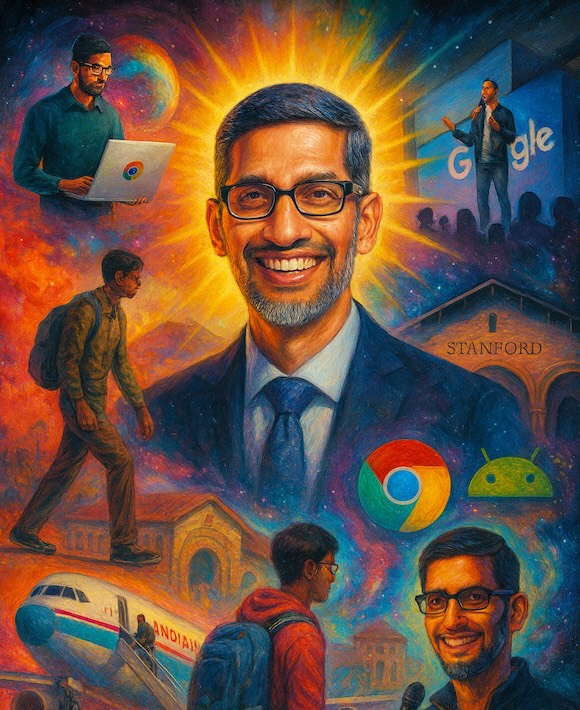
(Image by ChatGPT)
In the cutthroat world of Silicon Valley, where aggressive ambition, fierce competition, and a "move fast and break things" mentality often dominate the narrative, one of the most powerful leaders in technology stands out for an entirely different set of qualities. Sundar Pichai, the CEO of Google and Alphabet, has shattered the stereotype that success in the corporate arena requires a sharp elbow and an even sharper tongue.
His remarkable ascent from a small town in India to the helm of one of the world's most influential companies is a testament to a leadership philosophy rooted in humility, empathy, collaboration, and a profound sense of calm. Pichai proves, definitively, that nice guys can indeed finish first.
For decades, business literature and popular culture have perpetuated the image of the successful leader as a relentless, often intimidating figure. Think of the larger-than-life industrialists, the visionary-yet-demanding tech titans, or the high-pressure Wall Street moguls. This archetype suggests that effective leadership demands a certain level of aggression, an unshakeable conviction that borders on stubbornness, and a willingness to make unpopular decisions without a backward glance. Ambition is often equated with an almost predatory drive.
However, the modern workforce, increasingly diverse and globally connected, is often resistant to such autocratic styles. Employees today seek leaders who inspire, empower, and listen. They crave environments where psychological safety is prioritized, and where contributions are valued regardless of hierarchy. This shift has opened the door for leaders whose strengths lie not in dominance, but in their ability to connect, understand, and unite. Sundar Pichai is a quintessential example of this new paradigm.
From Humble Beginnings to Google's Core
Pichai's early life in Chennai, India, provides the bedrock for many of his defining traits. Growing up in a modest home without many luxuries, including a telephone until he was ten, instilled in him a grounded perspective and a deep appreciation for opportunity. His parents prioritized education, a value he carried with him through his studies at IIT Kharagpur, Stanford University, and the Wharton School.
This journey from scarcity to abundance didn't breed arrogance; it cultivated a quiet determination and an unwavering focus on the task at hand. When Pichai joined Google in 2004, the company was already a burgeoning giant, known for its innovative culture and engineering prowess. His initial role leading product management for Google Toolbar might seem minor in retrospect, but it was strategically crucial. It was a defensive move to ensure Google Search remained accessible even as Microsoft pushed its own browser. This early experience showcased Pichai's ability to tackle critical, albeit unglamorous, challenges with quiet efficiency.
The Chrome Masterstroke: Collaboration Over Command
Pichai's first major breakthrough, and a clear indicator of his unique leadership style, came with the development of the Google Chrome browser. At the time, conventional wisdom suggested Google, a search company, didn't need its own browser. Yet, Pichai saw the strategic imperative of owning the user's internet experience. Building Chrome required immense internal collaboration, convincing skeptical engineers and even co-founders Larry Page and Sergey Brin of its necessity.
>Instead of issuing mandates, Pichai employed his characteristic approach: he listened, he synthesized, and he built consensus. He didn't demand; he persuaded. He fostered an environment where engineers felt their contributions were valued, and their concerns heard. Chrome's eventual dominance—becoming the world's most popular web browser—is a testament not just to its technical superiority, but to the collaborative spirit Pichai instilled in its development. This success laid the foundation for Chrome OS and established Pichai as a leader capable of executing "big bets" through teamwork rather than top-down decree.
Unifying Platforms: Android and Beyond
By 2013, Pichai's responsibilities expanded dramatically to include Android, Google’s ubiquitous mobile operating system. This was a critical juncture. Android and Chrome, while both Google products, had historically operated with a degree of independence. Pichai was tasked with harmonizing these two colossal platforms. He achieved this not by imposing a rigid structure, but by creating bridges between teams, encouraging shared vision, and emphasizing user experience across all Google touchpoints.
His ascent continued rapidly. By 2014, he was overseeing nearly all of Google's product and engineering efforts, including Search, Maps, Gmail, and Ads. This consolidation of power wasn't a grab; it was a natural progression, recognized by Larry Page and Sergey Brin as Pichai's innate ability to bring cohesion to Google’s vast empire. He was seen as a unifying force, someone who could articulate a clear direction without alienating the brilliant, often opinionated, minds at Google.
Calm in the Eye of the Storm: Crisis Leadership
Perhaps Pichai's most compelling demonstrations of "nice guy finishes first" come during moments of intense crisis. Silicon Valley, for all its innovations, has faced its share of controversies, and Google has been no exception.When an internal memo propagating harmful stereotypes about diversity went viral and caused an uproar in 2017, Pichai handled the situation with a blend of firm conviction and empathetic understanding. He cut short a family vacation, addressed employees directly, and unequivocally condemned the memo's assertions as violating Google's Code of Conduct. He then took steps to ensure employee safety and reinforced the company's commitment to diversity, not with anger, but with a steady hand.
Similarly, during the unprecedented global employee walkout in 2018, sparked by concerns over sexual harassment and misconduct, Pichai responded with immediate action and genuine remorse. He acknowledged the company's failings, stating, "We recognize that we have not always gotten everything right in the past and we are sincerely sorry for that." Crucially, he followed up with concrete policy changes, making arbitration optional for individual sexual harassment claims – a key demand of the protestors.8 His response was not defensive, but rather reflective and responsive, embodying a leader who prioritizes trust and transparency over corporate image.
Even under the harsh glare of congressional hearings, where many tech CEOs have stumbled, Pichai maintains his composure. He answers questions patiently, often repeating explanations without visible frustration, embodying a quiet resilience. He navigates complex political landscapes not through aggression, but through a consistent and deliberate communication style that seeks to inform and de-escalate.
The New Definition of Strength
Sundar Pichai’s leadership is a masterclass in modern corporate statesmanship. His humility is not a weakness; it's a strength that allows him to listen and learn. His collaborative spirit isn't a lack of direction; it's a strategic choice that harnesses collective intelligence. His calm demeanor isn't a sign of indifference; it's a testament to his ability to think clearly under pressure.In an era demanding greater corporate responsibility and authentic leadership, Pichai represents a compelling model. He shows that true power doesn't come from autocratic command, but from the ability to inspire trust, foster inclusion, and steer a colossal organization with a steady, compassionate hand. Sundar Pichai’s journey to the top of Google is a powerful narrative, proving definitively that sometimes, the nicest guy in the room is also the most effective, ultimately finishing not just first, but also with integrity and widespread respect.
Recent Articles
- Job Openings Fell in March but Hiring and Layoffs Surged
- Musk Wanted $80 Billion to Colonize Mars Testifies OpenAI President
- Nasdaq Hits Record on Surging AI Chip Stocks
- Anthropic's Deep Push into Finance Tasks Likely to Disrupt Software Sector
- 'Yaris Moment' in the Works for Chinese Carmakers Chasing Overseas Growth
- Volvo's Q1 Full-EV Sales Rose 14% in Challenging Market
- Hong Kong Q1 GDP Expanded Fastest in Nearly Five Years
- Hugo Boss Beats on Profit Despite Iran
- PayPal Q1 Beats on Top Line on Spending by Affluent Consumers
- Coinbase Cuts Workforce on Crypto Market Volatility