

Chinese EVs Face Challenge from Biggest Carmaker You've Never Heard Of
By Goldsea Staff | 22 Feb, 2026
India's Tata Motors combines cost-efficient EV manufacturing with Chinese battery technology to expand into the global market.
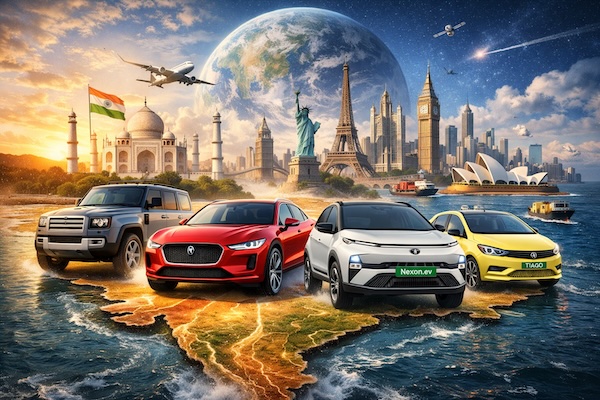
(Image by ChatGPT)
Most Americans have never heard of Tata Motors unless they happened across it in a business school case study, or perhaps seeing a 2008 news story when the Indian company had the audacity to buy Jaguar and Land Rover from Ford. But as a carmaker that competes for your wallet? Probably never considered it. That's about to change.
Dominant Conglomerate
Tata Motors is the automotive arm of the Tata Group, a Mumbai-based conglomerate so large and so deeply woven into Indian daily life that it's genuinely difficult to explain its scale to someone who hasn't experienced it firsthand.
Tata makes salt. It makes steel. It runs hotels, operates airlines, and builds software systems for Fortune 500 companies. Its revenues amount to roughly 8 percent of India's entire GDP.
And nestled within this empire is a car company that's currently the best-selling electric vehicle brand in the world's most populous nation, moving more EVs in India than every competitor combined. Yet outside South Asia, the name barely registers.
That's the paradox of Tata Motors. It's simultaneously a dominant force in its home market and an almost invisible one everywhere else. But the company has been quietly engineering a global push, and it's doing so by forming an unlikely alliance with the country most of the West would prefer it didn't: China.
Electrified for India
To understand why Tata matters, you first have to understand what's happening in India's auto market right now. India overtook Japan in 2023 to become the world's third-largest car market by volume, and it shows no sign of slowing down. A rapidly expanding middle class, urbanization at an extraordinary pace, and a government that's aggressively subsidizing EV adoption have turned the subcontinent into one of the most contested automotive battlegrounds on the planet. Tata has been winning that battle handily.
The company's electric lineup, led by the Nexon EV and the Tiago EV, has captured an audience that's hungry for affordable electrification. Where competitors have stumbled trying to localize their products for Indian roads, Indian budgets, and Indian driving habits, Tata has had the home-field advantage.
Its vehicles are built for the potholes. They're priced for the middle market. And they're backed by a brand that Indians have trusted for generations. That combination has given Tata a commanding lead in the domestic EV segment.
But commanding domestic leads don't pay for global ambitions, and Tata has its eyes on a much bigger prize.
The Chinese Connection
Here's where the Chinese connection becomes pivotal. Tata Motors has been deepening its relationship with Chinese battery and technology suppliers, most notably through partnerships that tap into the world-class manufacturing ecosystem that China has spent two decades building. Chinese battery technology, particularly lithium iron phosphate chemistry pioneered and refined by companies like CATL and BYD, offers a compelling combination of cost efficiency, thermal stability, and longevity that Western alternatives haven't yet matched at scale.
Tata isn't simply importing Chinese batteries and dropping them into existing vehicles. The strategy is more sophisticated than that. Tata Power, the group's energy division, has been building out battery assembly capacity in India that incorporates Chinese process technology and manufacturing know-how, allowing the group to localize production while still benefiting from the most advanced production techniques available globally. This is a model that other emerging-market manufacturers have tried to replicate with varying degrees of success, but Tata's sheer scale gives it leverage that smaller players don't have.
The geopolitical optics are complicated, admittedly. India and China share a contested border and a history of military standoffs. The Indian government has restricted Chinese app downloads, scrutinized Chinese investment, and encouraged domestic manufacturers to reduce their dependence on Chinese supply chains. Yet in the auto sector, pragmatism keeps winning out over politics. Chinese components are simply too good and too affordable to ignore when you're trying to compete globally on price.
Global Ambitions
The global push itself is unfolding on multiple fronts. Tata has been eyeing expansion into markets across Southeast Asia, the Middle East, Latin America, and eventually Europe. The United Kingdom market is particularly intriguing, not just because Tata already has a manufacturing footprint there through Jaguar Land Rover's plants in Solihull and Castle Bromwich, but because Britain's EV adoption targets create genuine demand for affordable electric vehicles. Tata's Indian-market EVs aren't ready for European roads in their current form — they'd need safety upgrades, software localization, and range improvements — but the roadmap exists.
The Jaguar-Land Rover Credibility
JLR itself is a crucial part of the story, though it's a complicated one. When Tata bought the British brands from Ford for $2.3 billion during the depths of the financial crisis, the acquisition was widely mocked. What did an Indian company know about building luxury British cars? Quite a lot, it turned out.
Tata nursed JLR back to profitability, invested billions in new models, and transformed it into a genuine global luxury player. The Range Rover Sport and the Defender became aspirational objects not just in England but across the Gulf states, China, and the United States. JLR now generates the majority of Tata Motors' global revenue.
But JLR's struggles during the semiconductor shortage and its complicated EV transition have reminded everyone that luxury British brands are a volatile asset. Tata can't build a global future on JLR alone. It needs its core business — those affordable, India-made, increasingly electrified vehicles — to grow beyond its borders.
Fortuitous Timing
The timing could actually work in Tata's favor. The global auto industry is experiencing one of its most disruptive periods since Ford introduced the assembly line. Traditional Western and Japanese automakers are spending enormous sums trying to retool their manufacturing processes for an electric future while simultaneously defending their existing combustion-engine businesses.
Chinese automakers like BYD have emerged as genuine threats, offering sophisticated EVs at prices that legacy brands can't easily match. American and European governments have responded by erecting tariff walls, but those walls don't protect every market in the world.
Into this fractured landscape comes Tata, with a cost structure shaped by Indian manufacturing, access to Chinese production technology, the global credibility of its JLR brands, and the experience of having already navigated one of the world's most demanding car markets. It's not trying to beat Tesla on technology. It's not trying to out-luxury Mercedes. It's threading a different needle entirely, aiming at the vast global middle ground where most of the world's car buyers actually live.
Would Americans buy a $19,000 EV with a 200-mile range? Tata thinks many would, along with consumers in most of the world. And their 2008 introduction of the $2,500 Nano — advertised perhaps too candidly as "the world's cheapest car" — has taught them how not to do it. You can bet they'll have a more appetiaing way to introduce an entry-level EV to consumers who want precisely that and no more.
Electric Pivot
The electric pivot has been the defining story of the most recent chapter. Tata Motors launched its EV division under the Tata.ev brand and has captured well over 60 percent of India's electric passenger vehicle market, driven by models like the Nexon EV, the Tiago EV, and the Punch EV. The group has backed this with serious infrastructure investment through Tata Power's charging network and battery assembly operations, creating a vertically integrated ecosystem that competitors have struggled to match.
Final Hurdles
There are real obstacles. Tata's vehicles will face serious scrutiny on safety ratings in any developed market. Its software and infotainment systems lag behind what Chinese and Western competitors offer. Building a brand from scratch in markets where it has no existing consumer awareness is expensive and slow. And the geopolitical complications of being an Indian company reliant on Chinese technology, selling into markets that are suspicious of both, will require constant diplomatic navigation.
But dismiss Tata at your own risk. This is a company that's already surprised the world once. When it bought JLR, pundits predicted disaster. Instead, it delivered Range Rovers to royalty. When rivals underestimated Indian consumers' appetite for EVs, Tata was already building a charging network and a product lineup that met them where they were. The company has a habit of being underestimated by people who aren't paying close enough attention.
Global Expansion
Today Tata Motors is among the top twenty automotive groups in the world by volume, employs hundreds of thousands of people directly and indirectly, and operates manufacturing facilities across India, the United Kingdom, and several other markets.
The global auto industry has spent the last decade learning, sometimes painfully, that disruption doesn't always come from Silicon Valley or Stuttgart. Sometimes it comes from places you weren't watching. If you haven't been watching Mumbai, it's probably time to start.
Recent Articles
- Your Answers to These 7 Questions Will Reveal Whether You're Sane or a Closet Lunatic
- US Oil Companies Profit from Strait of Hormuz Closure Says Russian Oil CEO
- Trump Faces New Republican Resistance in Congress as Midterms Approach
- SpaceX IPO Already Two Times Oversubscribed
- SpaceX Signs Google As AI Compute Client After Landing Anthropic
- $1 Trillion in Stock Market Valuation Erased by AI Chip Selloff
- Anthropic Urges Industry Pause As AI Nears Recursive Self-Development
- Trump's South Lawn UFC Birthday Bash to Mix Politics with Punches
- Trump Policies Targeting 39 Nationalities of Immigrants Invalidated
- One Man Holds Back the World's Progress toward Green Energy Sufficiency and Prosperity