

What Hit Movies Say About Americans, Chinese, Indians, Koreans
By Goldsea Staff | 27 Feb, 2026
The kind of movies we enjoy depend on what we perceive to be the big challenge of our lives.
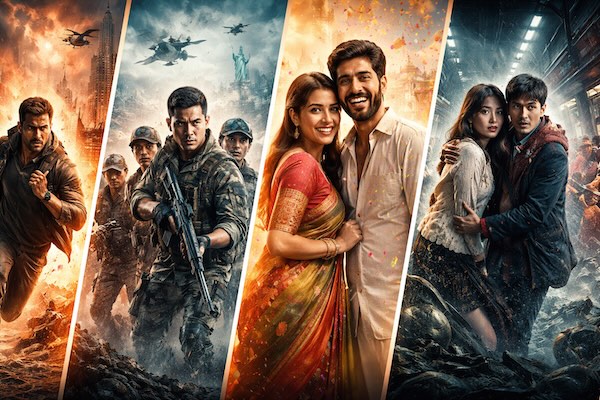
(Image by CatGPT)
To understand why some movies explode at the box office in one country but sink in another, look at the emotional arc of their . The stories that dominate a culture tend to mirror what people feel they’re up against in their own lives. When audiences sit down with popcorn, they’re not just looking for distraction. They’re looking for emotional rehearsal. They want to see their biggest challenges confronted, reframed and—at least for two hours—resolved.
Different societies wrestle with different pressures. So it’s no surprise that the most popular films in the United States, China, India and South Korea tend to run on distinct but revealing story arcs.

America: The Individual vs the System
The classic American arc is the lone individual who challenges a broken system. It’s baked into the national mythology: the rebel, the underdog, the self-made hero. You see it everywhere from “Rocky” to “Erin Brockovich” to “The Hunger Games.”
In “Rocky,” a small-time boxer fights not just Apollo Creed but his own low expectations and social class. In “The Shawshank Redemption,” Andy Dufresne outsmarts a corrupt prison system. In “Top Gun: Maverick,” an aging pilot pushes back against bureaucratic caution and technological replacement. Even superhero films like “Spider-Man” or “The Dark Knight” hinge on individuals who operate outside formal institutions because those institutions can’t quite handle the threat.
Why does this arc resonate so strongly? Because Americans are steeped in the idea that their biggest obstacle is impersonal power—government, corporations, elites, fate. The hero isn’t supposed to wait for collective salvation. He or she improvises, resists, innovates.
That’s why entrepreneurial biopics like “The Social Network” or “Air” catch fire. They dramatize the scrappy founder outmaneuvering entrenched players. The villain is often inertia, bureaucracy or complacency.
Even dystopian hits like “The Hunger Games” replay the same tension: a rigged system versus a defiant individual. Audiences don’t just root for Katniss. They’re rehearsing the fantasy that they, too, could bend the arc of a stacked world.

China: The Collective vs Chaos
In China, the dominant arc often flips the lens. It’s not primarily the individual versus the system. It’s the collective versus chaos—external threat, historical humiliation or cosmic disaster.
Take “Wolf Warrior 2,” where a former soldier protects Chinese citizens in a war-torn African country. The movie’s emotional engine isn’t lone-wolf rebellion. It’s national strength, competence and rescue. Similarly, “The Wandering Earth” imagines humanity—led prominently by Chinese scientists and officials—working together to literally move the planet out of danger. The spectacle is huge, but the underlying arc is about coordinated survival.
Historical epics like “The Battle at Lake Changjin” focus on collective sacrifice in the face of foreign aggression. Individual bravery matters, but it’s meaningful because it’s nested within national destiny. Even martial arts classics like “Hero” explore whether personal vengeance should yield to political unification.
This makes sense in a society where rapid modernization, geopolitical competition and historical memory loom large. For many viewers, the perceived challenge isn’t “How do I break free of my own system?” It’s “Can we remain strong and stable in a turbulent world?”
That’s why disaster movies and patriotic war films do so well. They offer reassurance that discipline, technology and solidarity can overcome existential threats. The villain is fragmentation, weakness or foreign encroachment. The emotional payoff comes when order is restored—not just for one person, but for the nation.

India: Family, Fate and Moral Triumph
In India, especially in mainstream Bollywood cinema, the dominant arc frequently centers on family, social mobility and moral vindication. The individual matters, but he or she is rarely detached from kinship and community.
Consider “Dangal,” in which a father trains his daughters to become wrestling champions. It’s a sports story, but it’s really about family ambition, gender norms and collective pride. In “3 Idiots,” three engineering students rebel against a rigid educational system—but the story ultimately circles back to friendship, parental expectations and redefining success.
Even grand historical blockbusters like “Baahubali: The Beginning” and “Baahubali: The Conclusion” revolve around lineage, betrayal and the restoration of rightful order. The hero isn’t just fighting for himself. He’s reclaiming honor for a family and kingdom.
Romantic dramas such as “Dilwale Dulhania Le Jayenge” or “Kabhi Khushi Kabhie Gham” hinge on reconciling love with parental approval. The core tension isn’t simply individual freedom. It’s how to harmonize personal desire with duty.
That reflects a society where rapid economic growth coexists with deep-rooted social structures. Many viewers experience their biggest challenges as navigating expectations—family pressure, class constraints, tradition versus aspiration.
So the most satisfying arc is moral triumph without total rupture. The hero may challenge injustice or corruption, but he doesn’t torch the social fabric. He reforms it, wins over skeptics and restores emotional balance. Audiences leave feeling that ambition and loyalty don’t have to be enemies.

South Korea: Society Is the Villain
South Korea’s biggest hits often run on a sharper, more ironic arc: the exposure of inequality and the shocking reversal of fortune. In a hypercompetitive, status-conscious society, the perceived challenge is frequently structural disparity—housing, jobs, class hierarchy.
No film captures this better than “Parasite.” The story begins as a clever con—poor but resourceful outsiders infiltrate a wealthy household. It morphs into a dark meditation on class resentment and invisible lines that can’t be crossed. The twist isn’t triumphant uplift. It’s tragic revelation.
Similarly, “Train to Busan” uses a zombie apocalypse to examine selfishness and sacrifice across class lines. Corporate executives, working fathers and marginalized passengers collide in a confined space. The crisis strips away status and exposes character.
Even historical dramas like “The Admiral: Roaring Currents” hinge on improbable reversal. A nearly defeated naval force outwits a stronger enemy. The emotional reward comes from strategic brilliance overturning grim odds.
Korean thrillers such as “Oldboy” or “The Man from Nowhere” revolve around vengeance and hidden networks of power. The protagonist often discovers that the game is bigger and darker than he imagined.
Why does this arc resonate? Because in a society defined by intense educational pressure, skyrocketing real estate prices and stark generational divides, many people feel squeezed. The stories don’t pretend the system is easily fixed. Instead, they dramatize its cruelty—and sometimes allow for explosive, cathartic payback.
The Global Blending of Arcs
Of course, these categories aren’t airtight. Hollywood now produces ensemble disaster films like “Avengers: Endgame” that echo collective arcs. Chinese directors experiment with more intimate character studies. Indian indie films tackle gritty social realism. Korean rom-coms offer pure escapism.
Still, the dominant commercial hits tend to reflect what a society senses as its central tension.
In the US, it’s the empowered individual versus a flawed system. In China, it’s the unified collective versus instability. In India, it’s personal aspiration woven into family and moral order. In South Korea, it’s inequality exposed and sometimes violently reversed.
When these films travel internationally, they sometimes need translation—not of language, but of emotional emphasis. “Parasite” succeeded globally because inequality is universal. “Wolf Warrior 2” resonated most strongly at home because it spoke directly to national pride. “3 Idiots” found fans across Asia because academic pressure isn’t uniquely Indian.
What Your Favorite Arc Says About You
The deck line isn’t just clever marketing. The kind of movies you enjoy really may depend on what you perceive to be your biggest life challenge.
If you’re drawn to American-style underdog stories, maybe you feel boxed in by rules or institutions. You want proof that grit can crack open a rigid world.
If Chinese disaster epics move you, maybe you crave stability and coordinated strength in uncertain times. You’d rather see order triumph than chaos celebrated.
If Bollywood family sagas make you tear up, perhaps your daily balancing act between ambition and obligation feels central to your identity. You want reassurance that you don’t have to choose one over the other.
If Korean thrillers and class dramas grip you, maybe you’re wrestling with status anxiety or structural unfairness. Watching the mask ripped off power feels like emotional justice.
Movies are communal dreams. They distill a culture’s anxieties into two hours of spectacle, music and dialogue. They don’t solve real-world problems, but they give shape to them. They offer scripts for courage, solidarity, reconciliation or revenge.
The next time a film becomes a runaway hit in Los Angeles, Beijing, Mumbai or Seoul, ask yourself what invisible fear it’s soothing. Is it fear of insignificance? Of instability? Of dishonoring family? Of being left behind?
The answer might tell you as much about society as any policy debate ever could.
© 2026 by Asian Media Group Inc.
Recent Articles
- Google Limits Meta’s Use of Its Gemini AI Models
- Key Volkswagen Shareholder Pitches Producing China Models in Germany
- S. Korea's Early World Cup Exit Triggers 'Utterly Baffled' Tirade by President
- Anthropic Allowed to Release Mythos AI Model to 'Tusted' US Organizations
- Apple Seeks Approval to Buy from Blacklisted Chinese Company to Ease Memory Crunch
- China's Industrial Profits Stay Resilient on Factories, Exports
- Meet the Teen Who Undertook a 7-Continent Solo Flight Against Cancer
- Getting Fit Pt. 2 - Raising Our Floor
- South Korea Survives World Cup Scare, Advances to Round of 32
- Why Asian-White Marriages Suffer Multiples the Disruption Rates of Asian-Asian Marriages